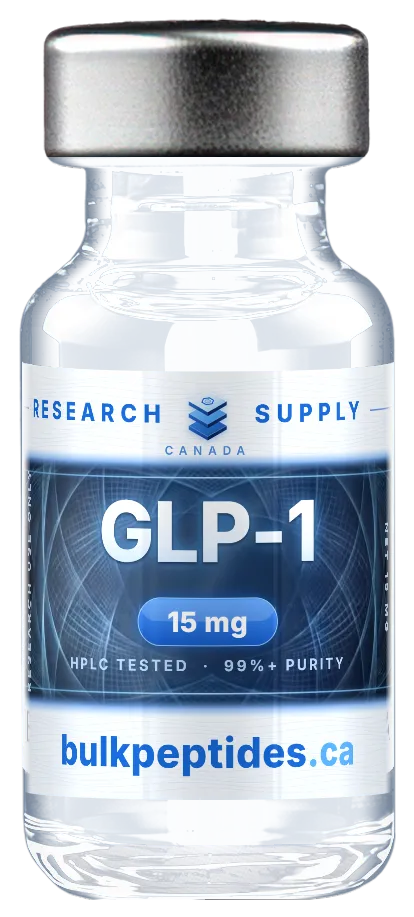
Sermorelin, tesamorelin and CJC-1295 (no DAC) are all synthetic analogs of growth hormone–releasing hormone (GHRH) that act at the same receptor, and they differ in length and chemical modification rather than in target. On a bulk order the 10mg sermorelin vial is the least expensive per milligram at $11.20 list and $7.28 at the 10+ tier, tesamorelin 10mg sits at $12.70 (falling to $8.25), and CJC-1295 no DAC, sold as a 5mg vial, costs $16.00 per mg at list and $10.40 at 10+.
Those per-milligram figures are only half the story for a three-way study, because the three molecules have very different molar masses. The sections below price them both ways, show how to build an equimolar panel into one discounted cart, and point to the articles that cover each analog in depth.
Price ladder for the three analogs
Arithmetic: list price ÷ label mg, then × 0.95, 0.85, 0.75 or 0.65 depending on the total vial count in the cart. The whole cart counts, so vials of different analogs combine toward one tier.
| Vial (CAD) | 1 vial | 2–3 | 4–6 | 7–9 | 10+ |
|---|---|---|---|---|---|
| Sermorelin 5mg: $94.99 ÷ 5 | $19.00 | $18.05 | $16.15 | $14.25 | $12.35 |
| Sermorelin 10mg: $111.99 ÷ 10 | $11.20 | $10.64 | $9.52 | $8.40 | $7.28 |
| Tesamorelin 10mg: $126.99 ÷ 10 | $12.70 | $12.06 | $10.79 | $9.52 | $8.25 |
| CJC-1295 no DAC 5mg: $79.99 ÷ 5 | $16.00 | $15.20 | $13.60 | $12.00 | $10.40 |
| CJC-1295 + Ipamorelin 10mg: $84.99 ÷ 10 | $8.50 | $8.07 | $7.22 | $6.37 | $5.52 |
Before planning a multi-vial order around tesamorelin, check current stock on its product page; if it is unavailable, the sermorelin and CJC-1295 rows still form a two-analog comparison.
Structural differences at a glance
| Feature | Sermorelin | Tesamorelin | CJC-1295 (no DAC) |
|---|---|---|---|
| Relation to GHRH | GHRH(1-29)NH2, the shortest fully active fragment | Full GHRH(1-44) | Modified GRF(1-29) |
| Residues | 29 | 44 | 29 |
| Modification | None beyond C-terminal amide | N-terminal trans-3-hexenoyl group | Four substitutions: D-Ala2, Gln8, Ala15, Leu27 |
| Molar mass | 3357.9 g/mol | 5135.8 g/mol | ~3367.9 g/mol |
| CAS | 86168-78-7 | 218949-48-5 | 863288-34-0 |
| Methionine at 27? | Yes | Yes | No (Leu) |
| Vial sizes here | 5mg, 10mg | 10mg | 5mg |
Cost per micromole and the equimolar panel
Comparing receptor analogs usually means comparing them at the same molar concentration, and here the milligram ranking breaks down. Tesamorelin is about 53% heavier than the two 29-residue analogs, so a milligram of it holds fewer molecules. Using label mass:
- Sermorelin 10mg: about 2.98 µmol, or $37.61 per µmol at list and $24.44 at 10+.
- Tesamorelin 10mg: about 1.95 µmol, or $65.22 per µmol at list and $42.39 at 10+.
- CJC-1295 no DAC 5mg: about 1.48 µmol, or $53.88 per µmol at list and $35.02 at 10+.
A convenient coincidence for panel work: one sermorelin 5mg vial (about 1.49 µmol) and one CJC-1295 5mg vial (about 1.48 µmol) are almost exactly equimolar, and one tesamorelin 10mg vial sits a little above them at 1.95 µmol. Three vials, one of each, already reach the 5% tier. Buying that set three times for triplicate runs gives nine vials and 25% off; add one spare sermorelin and the cart crosses into the 35% tier. Net peptide content on the certificate should replace label mass once you calculate working stocks; the molarity calculator takes both.
Telling them apart analytically
Sermorelin and CJC-1295 no DAC are separated by only about 10 g/mol. The four substitutions in CJC-1295 nearly cancel in mass (Asn to Gln and Gly to Ala each add a methylene, Met to Leu trades a sulphur for a methylene for a net loss of about 18, and the D-alanine swap changes stereochemistry but not mass), so a low-resolution mass reading alone can blur the two. Retention time on HPLC and an accurate mass on the correct charge state are what separate them. Tesamorelin, at over 5,100 g/mol, is distinct by mass but shows more charge states in electrospray. Products are third-party tested by HPLC and purity testing at 99%+ purity, certificates for some products appear on the COAs page, and cap and crimp colour ties each vial to its certificate. For reading one, see how to read a peptide certificate.
What the literature looks at
All three bind the GHRH receptor, a class B G-protein-coupled receptor, and receptor-level studies typically measure binding and cAMP signalling in pituitary-derived or receptor-expressing cells. The modifications exist mainly to change how long the peptide survives: native GHRH fragments are cut between Ala2 and Asp3 by dipeptidyl peptidase-4. Tesamorelin’s N-terminal acyl group and CJC-1295’s D-Ala2 are two different answers to that cleavage, while Gln8, Ala15 and Leu27 in CJC-1295 target deamidation, helix stability and oxidation. The articles on sermorelin as the reference analog, tesamorelin’s stabilised design, CJC-1295 with and without DAC and half-life modifications go further.
The CJC-1295 + Ipamorelin blend is a different pairing
The blend is not a fourth GHRH analog. It combines CJC-1295 no DAC, acting at the GHRH receptor, with ipamorelin, a pentapeptide that acts at the ghrelin receptor GHS-R1a, in a fixed 5+5 vial. That makes it a two-receptor pairing suited to designs that deliberately engage both pathways, and it is the cheapest per milligram of anything on this page. It is analysed in the blend composition article; for the receptor distinction see GHRH analogs versus secretagogues and ipamorelin selectivity.
Picking vial sizes for the stage of work
- Setting up an assay: sermorelin 5mg is the natural first vial, since it is the unmodified reference fragment. Pair it with a CJC-1295 5mg vial to reach 5% off.
- Running the full series on one analog: sermorelin 10mg gives the lowest cost per mg of the three.
- A three-analog comparison: the equimolar set above, repeated per replicate batch, ordered in one cart.
- Two-receptor work: the CJC-1295 + Ipamorelin blend, with single ipamorelin and CJC-1295 vials as controls.
Storing a mixed analog order
Sermorelin and tesamorelin both keep the native Met27, which can oxidise, so limit air exposure once a vial is opened and aliquot rather than reopening. CJC-1295’s Leu27 removes that concern but not the general need for cold, dry storage; storage guidance for lyophilised peptides applies to all three. Write down the batch on each certificate at delivery and quote it when topping up.
Common questions
Which GHRH analog is cheapest to buy in volume?
Sermorelin 10mg per milligram ($7.28 at 10+). Per micromole it is also the cheapest of the three single analogs.
Can I mix all three in one order for the discount?
Yes. The bulk pricing ladder counts every vial in the cart, whatever the compound.
Why is CJC-1295 so close in mass to sermorelin?
Its four substitutions nearly offset one another in mass, leaving a gap of about 10 g/mol.
Is tesamorelin just a longer sermorelin?
It is the full 44-residue sequence, of which sermorelin is the first 29 residues, plus an N-terminal trans-3-hexenoyl group.
Is the CJC-1295 + Ipamorelin blend a substitute for the singles?
No. It fixes a 1:1 mass ratio of two compounds acting at different receptors.
See the price list, the shop, or every peptide comparison on this site.
For laboratory research use only. Not for human or veterinary use.