
Buying copper peptides in Canada in quantity means buying a metal complex rather than a plain peptide — and that one fact shapes how the material should be identified on receipt, stored and checked analytically. Everything here ships as freeze-dried powder, strictly for laboratory research use only.
Copper peptides in Canada: what we stock
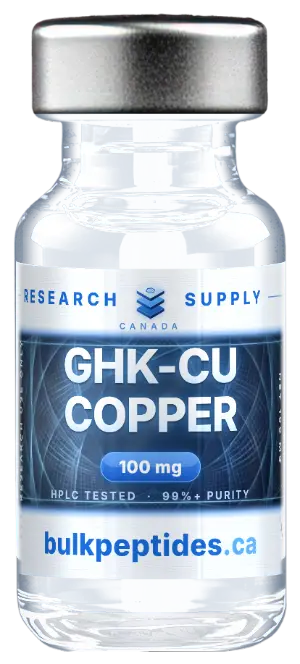
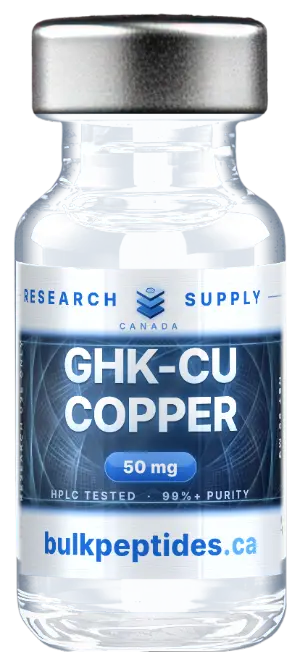
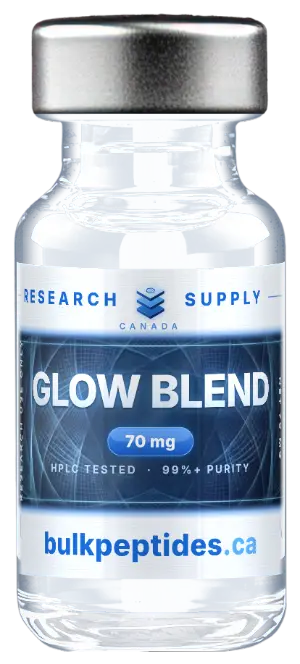
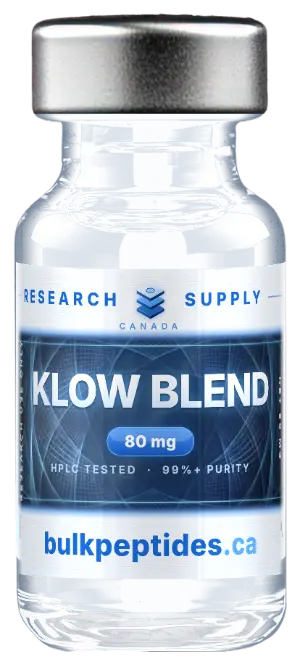
GHK-Cu comes in 50 mg and 100 mg vials, suiting labs that prefer fewer, larger vials. It is also the 50 mg component of both GLOW and KLOW among our multi-peptide blends — worth remembering when comparing what a blend costs with a single-compound vial. Vials across products combine toward the volume discount tiers, and the GHK-Cu Canada page has more on ordering it in bulk.
Two registry numbers, two substances
- GHK (glycyl-L-histidyl-L-lysine), the free tripeptide: CAS 49557-75-7, 340.38 g/mol, C14H24N6O4.
- GHK-Cu, the copper(II) complex, registered as copper tripeptide-1: CAS 89030-95-5, approximately 402.92 g/mol, C14H23CuN6O4.
Supplier listings often swap these CAS numbers as though they meant the same thing. They do not: one identifies an organic tripeptide, the other a coordination compound about 62 Da heavier. When QC staff compare certificates, the first item to confirm is which registry number and which mass the document actually reports — paperwork written for the free peptide gives no information on whether copper is present, let alone bound.
What the copper changes at the bench
Three donor atoms hold the metal in place: the imidazole nitrogen on histidine's side chain, the N-terminal amine and a nitrogen from the backbone. An ordinary peptide has none of the resulting quirks:
- Colour. The complex absorbs in the visible range, so GHK-Cu powder is blue, not white. Colour is therefore a rough yet genuine check at receiving — photograph any cake that looks off-colour or patchy when the box is opened.
- Chromatography. On reverse-phase columns the copper complex does not behave like the free peptide, so traces of the two cannot be compared directly.
- Redox sensitivity. Copper can be oxidised and reduced, leaving the complex vulnerable to conditions a simple tripeptide would tolerate.
- Mass spectrometry. The copper isotope pattern appears in the spectrum, confirming the metal is really there rather than presumed.
More depth is in our notes on how copper binds in GHK-Cu and interpreting an HPLC trace.
Certificates, matching and storage
Products are third-party tested, and where a certificate is published it sits on the COAs page in the form the laboratory released it. Vials are matched to their certificate by cap and crimp colour, which makes a multi-vial delivery straightforward to log. Because the copper is redox active, storage conditions matter more in this category than for an unmodified tripeptide — our guide to light, oxygen, temperature and peptide breakdown covers the variables.
For laboratory research only — not for human or veterinary use. These materials hold no Health Canada or FDA authorisation, carry neither a DIN nor an NPN, and are not produced under pharmaceutical GMP.