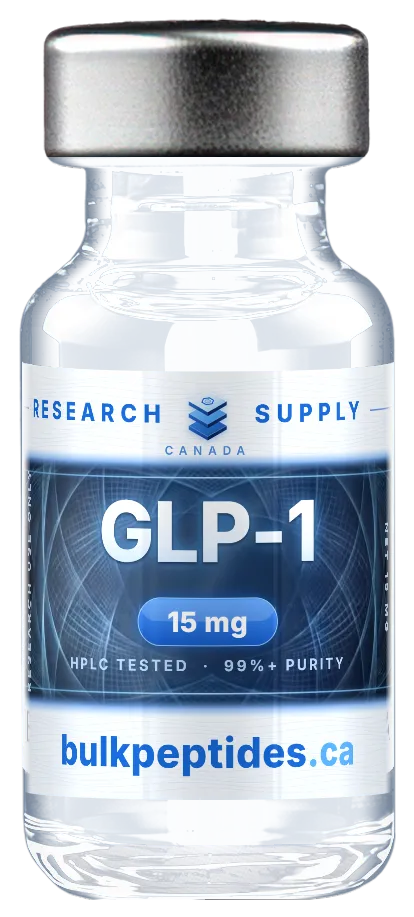
Our research peptides Canada FAQ is written for the people who place and receive volume orders: lab managers, purchasing leads and QC staff. It covers pricing, tax, delivery, certificates and storage. Anything missing? Send us a message.
Research peptides Canada FAQ: ordering by volume
How are quantity discounts calculated?
The break follows the total vial count in the cart, in any mix of compounds and strengths. Two or three vials take 5% off each one, four to six take 15%, seven to nine take 25%, and ten or more take 35%. No code is needed. Past a few cases, ask for a custom quote. The full ladder is on the bulk pricing page.
How can an order be paid?
By e-Transfer, USDT or one of the selected cryptocurrencies offered at checkout.
Which sales tax is added?
GST or HST is set at checkout by the province or territory on the shipping address, not the billing one.
- 13% HST: Ontario
- 14% HST: Nova Scotia
- 15% HST: Prince Edward Island, New Brunswick, and Newfoundland and Labrador
- 5% GST: British Columbia, Alberta, Saskatchewan, Manitoba, Quebec, Yukon, the Northwest Territories and Nunavut
HST shows as one combined federal-provincial line. A GST/HST-registered lab or institution recovers it as an input tax credit in the usual way; our quotes are prepared before tax, with tax listed on its own line.
A domestic parcel never passes through customs, so there is no duty or brokerage. Imported orders attract both, with brokerage collected by the carrier at the door rather than when you pay.
Delivery inside Canada
Can you deliver outside Canada?
No. We deliver to Canadian addresses only, and every order is packed and sent from within the country, so no border clearance or broker is involved.
When does shipping cost nothing?
Any Canadian order above $200 CAD ships free, which covers most multi-vial orders. A valid free-shipping coupon entered at checkout also removes the charge.
Does a large order need ice packs?
No. Freeze-dried powder tolerates an ordinary transit window, so standard delivery goes without cold chain. Long spells at room temperature after arrival should still be avoided.
Testing and certificates
Is the material independently tested?
Yes. Products go to an independent third-party lab for HPLC and purity testing. Certificates for some products are published on the COAs page; if the one you want is not there, ask us for it. Every certificate carries photographs of the batch it covers.
What figures do the certificates show?
Each one reports the third-party HPLC and purity results for the lot it identifies. Against our specification of 99%+, results usually land from 99.7% to 99.9%.
There is no batch number on the vial. How do I tie it to a certificate?
By cap and crimp colour, checked against the batch photographs on that product’s certificate when the box is unpacked, before anything is put away. Download the certificate and file it with your receiving log; a bookmark is not a record. Our checklist for incoming shipments goes through the rest.
Net content and storage
Why is there less than 10mg of peptide in a 10mg vial?
Freeze-dried peptides are salts, usually the trifluoroacetate form, and they draw in moisture. Label weight therefore includes counter-ion and water, and the peptide itself is normally 70-90% of it. Calculate concentrations from that net figure, not the label; across a multi-vial order the gap adds up.
What should happen to an order when it is received?
Put the sealed vials straight into a fridge at 2-8 C. Before first use, let a vial warm to room temperature while still closed so airborne moisture cannot condense on the powder, and close it again quickly. Aliquot at first opening so the material is not warmed and chilled repeatedly.
Compounds and compliance
How do the GLP-1, GLP-2 and GLP-3 products differ?
By receptor count. GLP-1 acts at the GLP-1 receptor alone. GLP-2 is an agonist at two incretin receptors. GLP-3 acts at those and at the glucagon receptor as well. Each of these receptors belongs to class B1 of the G-protein-coupled family, with signalling running mainly through Gs and cAMP.
What does “research use only” cover?
The material is sold for in vitro and laboratory work. It is not an authorised health product: Health Canada has not reviewed it for safety or efficacy in people, it has no Drug Identification Number, and it is not sold to be given to humans or animals.
Can research peptides be bought legally in Canada?
None of our compounds appears in the schedules of the Controlled Drugs and Substances Act. They are sold as research materials, not authorised health products. Read that narrowly: a substance outside the CDSA can still be treated as an unapproved drug for Food and Drugs Act purposes once it is marketed for human use. The buyer is responsible for checking legal status and permitted uses in their own jurisdiction. Our summary of how Canadian law treats research peptides lays out the framework; it is general information, not legal advice.
Will you advise on dosing or administration?
No, not through any channel. We do not give dosing schedules, administration routes, cycle protocols, or reconstitution volumes framed as a dose. Our analytical, storage and handling notes exist so material can be identified, checked and kept properly, not as directions for using it in people or animals. A seller offering that advice has abandoned the research-use-only position its own disclaimer relies on.
Every product is sold for laboratory research use only. None is approved for human consumption or for clinical or veterinary use.