
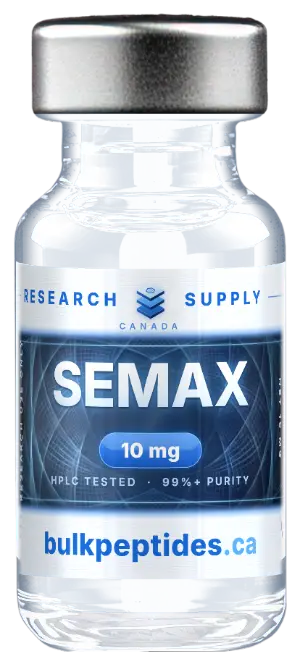
Labs sourcing neuropeptides in Canada will find the compounds below, each shipped as freeze-dried powder, strictly for laboratory research use only. Each one either comes from or is patterned on a native signalling peptide; for most, the research interest lies in what a small structural change does to the parent sequence.
Neuropeptides in Canada: quick reference
- Semax — ACTH(4-7) with a Pro-Gly-Pro tail
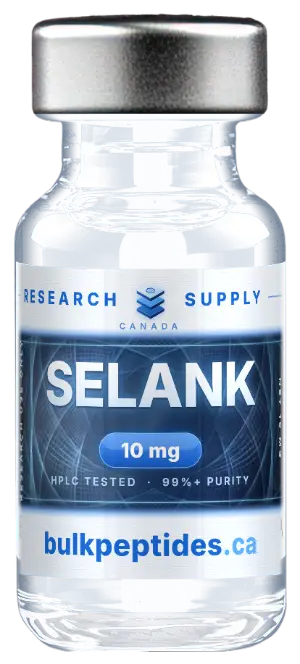
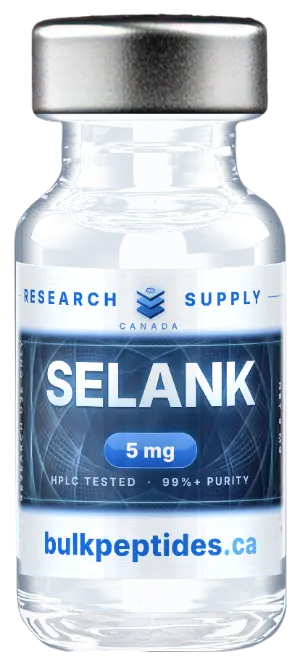
- Selank — tuftsin analog with the same Pro-Gly-Pro tail
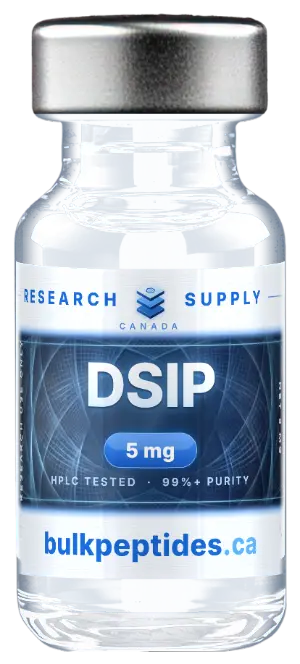
- DSIP — nine-residue peptide, no established receptor
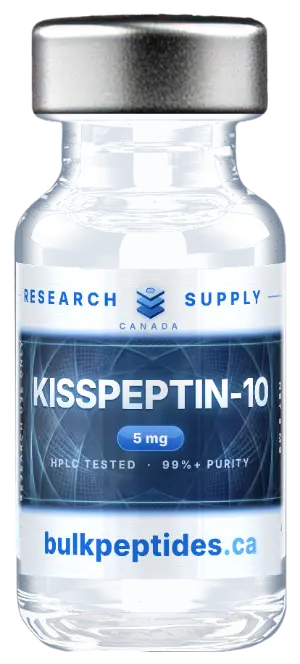
- Kisspeptin-10 — KISS1-derived, acts at KISS1R
- Epithalon — four-residue peptide
Mixed orders across these compounds count toward the volume tiers.
Semax and Selank: one design strategy, two parents
Semax: CAS 80714-61-0, approx. 813.9 g/mol, C37H51N9O10S, sequence MEHFPGP. Selank: CAS 129954-34-3, approx. 751.9 g/mol, C33H57N11O9, sequence TKPRPGP. Both carry a Pro-Gly-Pro extension added to the native fragment, intended to alter how fast peptidases break the molecule down — the same tactic applied to unrelated parent sequences. See Semax, Selank and derivatives of endogenous peptides and modifications that set half-life.
QC note: Semax includes a methionine, so it can oxidise. On a certificate, the impurity to check for is a species 16 mass units above the target.
DSIP (delta sleep-inducing peptide)
CAS 62568-57-4, approx. 848.8 g/mol, C35H48N10O15, nine residues: WAGGDASGE. What sets it apart in this group is how sparse and dated much of its literature is, and that no single receptor has yet been identified for it — a point to weigh before building a study around it. See a review of the DSIP literature.
Kisspeptin-10
A decapeptide from the C-terminal end of the protein encoded by the KISS1 gene, acting at KISS1R: CAS 374675-21-5, approx. 1,302.4 g/mol, C63H83N17O14, sequence YNWNSFGLRF-NH2. In contrast to DSIP, its receptor is well characterised and its signalling pathway clear, which makes it a far more tractable tool for research. See Kisspeptin-10 and signalling through KISS1R.
Epithalon
A four-residue peptide (AEDG; CAS 307297-39-8; 390.35 g/mol; C14H22N4O9) and among the smallest molecules we carry. That small size helps analytically as well: four residues give an early retention time and an uncomplicated mass spectrum, so identity is relatively simple to confirm. See reviewing the Epithalon evidence.
Testing and receiving
Products are third-party tested, published certificates are on the COAs page in the form the lab issued them, and each vial is tied to its own certificate by cap and crimp colour. Several of these sequences place an aspartate or asparagine next to a glycine — the textbook deamidation motif; see how peptide impurities form.
For laboratory research only — not for human or veterinary use. These materials hold no Health Canada or FDA authorisation, carry neither a DIN nor an NPN, and are not produced under pharmaceutical GMP.