Description
Sermorelin is the reference point for every modified GHRH fragment that came after it. If a lab wants the unaltered 1-29 sequence as a comparator, this is the vial.
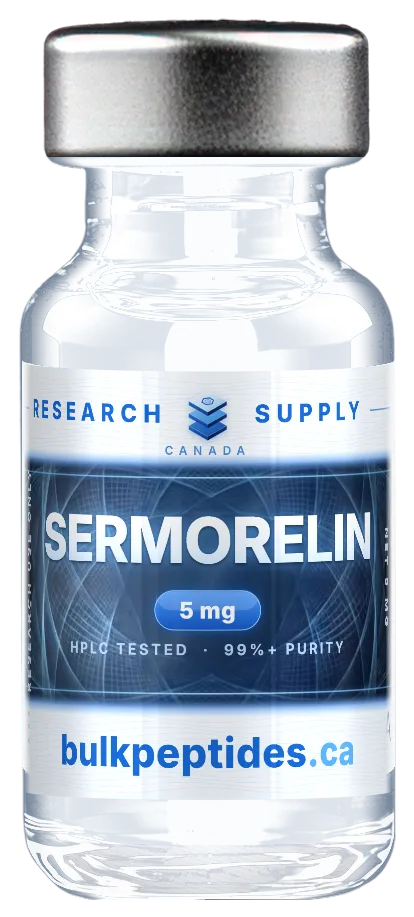
Sermorelin 5 mg, the native GRF(1-29) sequence
The peptide reproduces the first 29 amino acids of human growth-hormone-releasing hormone with a C-terminal amide, which is the shortest stretch of the 44-residue hormone that keeps full activity at the GHRH receptor. It contains a methionine at position 27, and that residue is the usual site of oxidation, so an extra early-eluting peak on HPLC is something to recognise rather than ignore.
Because it is unmodified, sermorelin is broken down quickly by dipeptidyl peptidase-4 in serum-containing media. Labs comparing it with protease-resistant analogues such as CJC-1295 without DAC use exactly that difference as the experimental variable.
Compound identity and specification
| Compound | Sermorelin |
|---|---|
| Sequence | GRF(1-29) amide, the first 29 residues of human growth-hormone-releasing factor with a C-terminal amide |
| Molecular formula | C149H246N44O42S |
| Molecular mass | 3357.9 g/mol |
| CAS registry number | 86168-78-7 |
| PubChem | CID 16132413 |
| Vial content | 5 mg |
| Physical form | Lyophilised powder in a sealed vial |
| Analysis | Third-party HPLC and purity testing to a 99%+ specification; certificates are posted on our COAs page |
| Supplied for | Laboratory research use only |
Questions about Sermorelin Peptide 5mg
How does sermorelin differ from tesamorelin?
Sermorelin is GRF(1-29) amide. Tesamorelin is the full 44-residue GHRH with a trans-3-hexenoyl group on the N-terminus.
What causes a small extra peak near the main one?
Methionine oxidation is the most common reason. Storing the powder cold, dry and away from air limits it.
Is a 10 mg vial available?
Yes. The 10 mg format suits longer series and costs less per milligram.
Research literature
Peer-reviewed studies involving this compound and its class. All findings listed are from in vitro, cell culture or animal models and are provided for scientific reference only. This product is supplied for laboratory research and is not approved for human consumption, clinical, or veterinary use.
- Lance VA, et al. Biochem Biophys Res Commun. 1984;119(1):265-272. Structure-activity study measuring GH-releasing potency of GRF(1-29)-amide and substituted analogs in cultured pituitary cells and rodent assays. Source · PMID 6231028
- Clark RG, Robinson ICAF Nature. 1985;314(6008):281-283. In normal and GHRF-deficient rats, measured growth rate and pituitary GH content under pulsatile versus continuous infusion at a matched daily total. Source · PMID 2858818
- Frohman LA, et al. J Clin Invest. 1989;83(5):1533-1540. In human plasma in vitro, measured enzymatic cleavage sites and degradation kinetics, identifying DPP-IV N-terminal cleavage as the inactivating step. Source · PMID 2565342
Literature notes: This molecule is indexed in the primary literature as GRF(1-29)NH2 or GHRH(1-29)NH2 rather than under the name sermorelin.
Certificates for our compounds are posted on the certificates of analysis page and matched to vials by cap and crimp colour. If the one for this product is not up yet, contact the order desk.
Related research compounds
Browse more compounds in GHS, or view the full research peptide catalogue.
Background on the compound: sermorelin, GHRH(1-29) and the reference analog — where DPP-4 cleaves it, why the C-terminal amide matters, and how it compares with tesamorelin and CJC-1295.
Supplied for laboratory research use only. Not for human or veterinary use.