Description
Larger fills make sense for peptides a lab keeps returning to. Sermorelin is one of those, because it is the unmodified baseline against which GHRH analogues are judged.
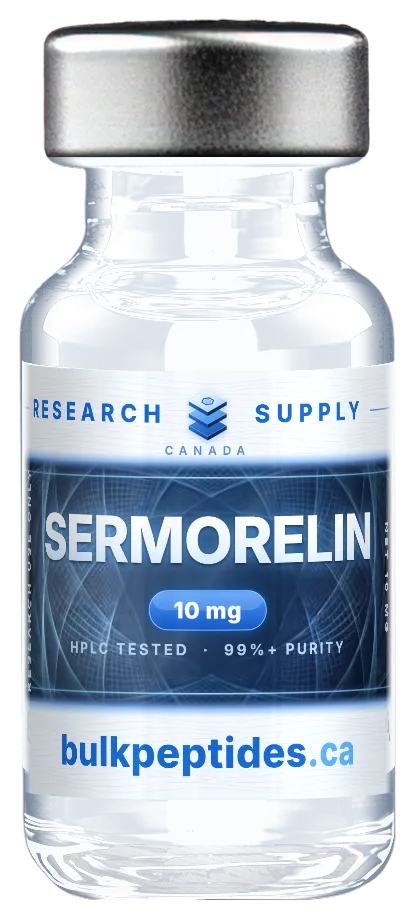
Sermorelin 10 mg for extended GHRH-receptor work
At 3357.9 g/mol, sermorelin is a mid-sized peptide, large enough that its HPLC profile is sensitive to small changes in sequence or oxidation state and small enough to synthesise with high fidelity. Its formula, C149H246N44O42S, includes the single sulphur atom of methionine 27.
Typical uses are cAMP and reporter assays in cells expressing the GHRH receptor and release studies in pituitary cell preparations. Running the whole series from one 10 mg vial removes supply as a variable, which matters most when the point of the experiment is a comparison with modified analogues.
Compound identity and specification
| Compound | Sermorelin |
|---|---|
| Sequence | GRF(1-29) amide, the first 29 residues of human growth-hormone-releasing factor with a C-terminal amide |
| Molecular formula | C149H246N44O42S |
| Molecular mass | 3357.9 g/mol |
| CAS registry number | 86168-78-7 |
| PubChem | CID 16132413 |
| Vial content | 10 mg |
| Physical form | Lyophilised powder in a sealed vial |
| Analysis | Third-party HPLC and purity testing to a 99%+ specification; certificates are posted on our COAs page |
| Supplied for | Laboratory research use only |
Questions about Sermorelin Peptide 10mg
Why choose sermorelin over a modified analogue?
When the question is how the native sequence behaves, or when you need a baseline for comparing analogues.
How should an opened vial be stored?
Divide dissolved material into single-use portions and freeze them, so the main supply is not repeatedly thawed.
Does sermorelin 10 mg qualify for quantity breaks?
Yes. Two or more vials start the breaks, and ten or more reach 35% off.
Research literature
Peer-reviewed studies involving this compound and its class. All findings listed are from in vitro, cell culture or animal models and are provided for scientific reference only. This product is supplied for laboratory research and is not approved for human consumption, clinical, or veterinary use.
- Lance VA, et al. Biochem Biophys Res Commun. 1984;119(1):265-272. Structure-activity study measuring GH-releasing potency of GRF(1-29)-amide and substituted analogs in cultured pituitary cells and rodent assays. Source · PMID 6231028
- Clark RG, Robinson ICAF Nature. 1985;314(6008):281-283. In normal and GHRF-deficient rats, measured growth rate and pituitary GH content under pulsatile versus continuous infusion at a matched daily total. Source · PMID 2858818
- Frohman LA, et al. J Clin Invest. 1989;83(5):1533-1540. In human plasma in vitro, measured enzymatic cleavage sites and degradation kinetics, identifying DPP-IV N-terminal cleavage as the inactivating step. Source · PMID 2565342
Literature notes: This molecule is indexed in the primary literature as GRF(1-29)NH2 or GHRH(1-29)NH2 rather than under the name sermorelin.
Certificates for our compounds are posted on the certificates of analysis page and matched to vials by cap and crimp colour. If the one for this product is not up yet, contact the order desk.
Related research compounds
Browse more compounds in GHS, or view the full research peptide catalogue.
Background on the compound: sermorelin, GHRH(1-29) and the reference analog — where DPP-4 cleaves it, why the C-terminal amide matters, and how it compares with tesamorelin and CJC-1295.
Supplied for laboratory research use only. Not for human or veterinary use.