Description
Tesamorelin is the largest peptide in our catalogue. At 44 residues plus an acyl cap, it behaves differently on the bench from the short fragments most labs are used to.
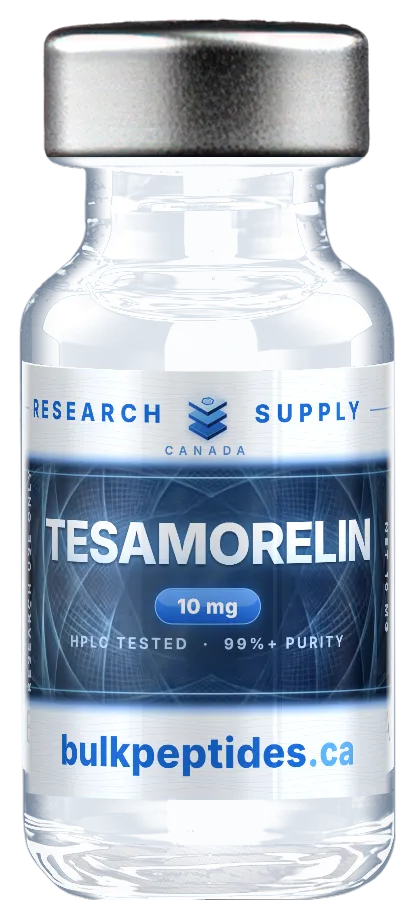
Tesamorelin 10 mg, full-length and N-terminally capped
The molecule is the complete 44-amino-acid sequence of growth-hormone-releasing hormone with a trans-3-hexenoyl group attached to the N-terminal tyrosine. That cap protects the first two residues from dipeptidyl peptidase-4, the enzyme that inactivates native GHRH within minutes. The result is a GHRH-receptor agonist with a molecular mass of about 5136 g/mol.
Size has practical consequences. Tesamorelin needs a longer or shallower HPLC gradient to resolve from closely related impurities, and it is more prone to adsorbing onto plastic at low concentrations, so low-binding tubes are worth using for dilute working solutions.
Compound identity and specification
| Compound | Tesamorelin |
|---|---|
| Sequence | trans-3-hexenoyl-GRF(1-44) amide |
| Molecular formula | C221H366N72O67S |
| Molecular mass | 5136 g/mol |
| CAS registry number | 218949-48-5 |
| PubChem | CID 16137828 |
| Vial content | 10 mg |
| Physical form | Lyophilised powder in a sealed vial |
| Analysis | Third-party HPLC and purity testing to a 99%+ specification; certificates are posted on our COAs page |
| Supplied for | Laboratory research use only |
Questions about Tesamorelin 10mg
How is tesamorelin related to sermorelin?
Sermorelin is residues 1 to 29 of GHRH. Tesamorelin is all 44 residues with an added hexenoyl cap.
Why does tesamorelin stick to plasticware?
Long peptides with hydrophobic stretches adsorb to surfaces, which matters most in dilute solutions. Low-binding tubes reduce the loss.
What is the vial content?
10 mg of lyophilised peptide, with the identity data listed in the table below.
Research literature
Peer-reviewed studies involving this compound and its class. All findings listed are from in vitro, cell culture or animal models and are provided for scientific reference only. This product is supplied for laboratory research and is not approved for human consumption, clinical, or veterinary use.
- Ferdinandi ES, et al. Basic Clin Pharmacol Toxicol. 2007;100(1):49-58. In rats, dogs and pigs, measured enzymatic stability of the trans-3-hexenoyl modification, plasma elimination kinetics and plasma IGF-1 response. Source · PMID 17214611
Literature notes: Preclinical literature for this compound is limited; most published work reports clinical endpoints and is outside the scope of this reference list.
Certificates for our compounds are posted on the certificates of analysis page and matched to vials by cap and crimp colour. If the one for this product is not up yet, contact the order desk.
Related research compounds
Browse more compounds in GHS, or view the full research peptide catalogue.
Supplied for laboratory research use only. Not for human or veterinary use.