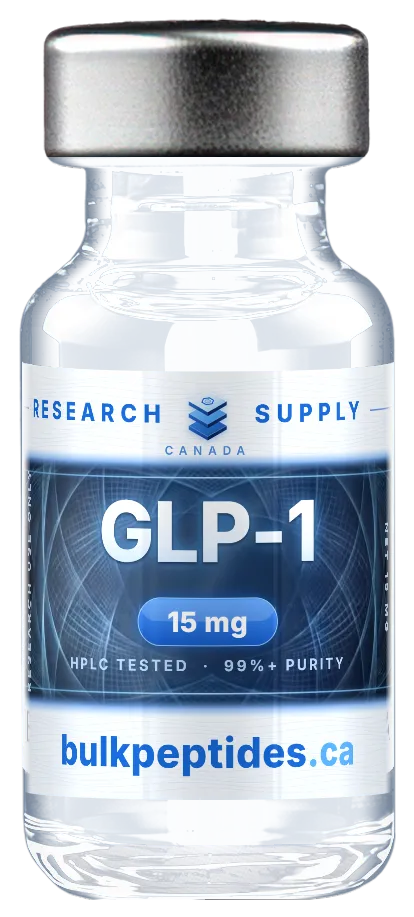
Our peptide purity guarantee is simple: have any compound we sell analysed by a laboratory of your choosing, and if it misses specification you get your money back, plus what the analysis cost. Our own certificates are a starting point, not something you are asked to take on faith.
The peptide purity guarantee in full
Where an independent analysis shows that a compound does not meet the specification given on its certificate of analysis, we make a full refund that includes your testing fees. The condition is that the unused product comes back to us together with the documents that support the result.
Few suppliers in this market will pay for someone to test them. We do, because a published certificate only means something if it can be proven wrong.
Where certificates live and how a vial is matched
We do not pack certificates in the box. They are published on the COAs page and added as each one is issued. If the one for your compound has not appeared yet, get in touch and we will send it.
There is no printed batch number on our vials. Instead, each vial is matched to its certificate by cap and crimp colour, compared with the photographs printed on the certificate. On a multi-vial order, do that check for every vial as it is logged in.
Each certificate reports third-party HPLC and purity testing and names the lot it covers along with the analytical method and conditions.
Reading a certificate before you rely on it
Two minutes with a COA catches most problems, and it is worth doing once per lot on receipt.
- Identity comes before purity. A measured mass that agrees with the calculated mass tells you what the compound is. A purity figure only matters once that question is answered.
- Look at the trace, not only the percentage. One sharp main peak on a flat baseline supports the reported number. Several unresolved shoulders integrated as one peak do not. Our guide to reading an HPLC trace for a peptide walks through it.
- Find the net peptide content. Freeze-dried peptide includes counterions and leftover water, so the gross weight in the vial overstates the peptide, often by fifteen to twenty-five percent. Concentrations cannot be calculated properly without this figure; see net peptide content, explained.
- Note the counterion. Trifluoroacetate left over from purification is itself active in certain cell assays. The consequences are covered in counterions and salt forms.
- Notice what is missing. HPLC and MS say nothing about endotoxin or sterility, and a certificate that is silent on them means they were not tested. The terms are explained in endotoxin, sterility and research grade.
Sending a vial to another lab
Any analytical lab that characterises peptides can run the test. Before you set their numbers beside ours, bear two things in mind.
First, purity depends on the method. Detection wavelength, how steep the gradient is and how peaks are integrated all shift the result, so two labs reporting different figures is not, on its own, a sign that anything is wrong. Our article on why two COAs can give different purity figures sets out the sources of variation.
Second, identity and purity answer different questions. Mass spectrometry confirms that the main peak is the sequence you ordered; a purity percentage only tells you how homogeneous the sample is. More in verifying peptides by HPLC and mass spec.
Why results from two labs may not agree
This accounts for most cases where a buyer believes a certificate is wrong and it is not. RP-HPLC purity is an area-percent measurement, and it changes with the method.
- Gradient. A steep gradient shortens the run and can hide deletion sequences inside the main peak. A shallow one separates them and gives a lower figure for identical material.
- Wavelength. At 214 nm the detector sees the peptide bond and picks up almost everything; at 280 nm it sees only aromatic residues. One sample returns different area percentages at the two settings.
- Column. Different stationary phases separate different pairs of impurities, and a worn column resolves less well.
- Integration. Where the baseline is drawn and where peaks are split can move the answer, occasionally by over a percentage point.
That does not make the test unreliable. It makes it dependent on method, and that is why the conditions should be printed on the certificate. For the full picture, see why purity results differ between certificates and independent versus in-house testing.
Five questions that give “lab tested” a meaning
On its own the phrase says almost nothing, because every seller in this market uses it. A claim you can act on is separated from an empty one by five details, and a Canadian supplier ought to answer each of them straight away.
- Who performed the analysis? A supplier’s own instrument and an outside analytical lab are two different levels of assurance. Either is legitimate; blurring the two is not. The certificate should state which one applies.
- Which batch is it about? If a certificate cannot be linked to the vial on your bench, it is decoration. Some link is required. Many sellers print a lot code; ours is cap and crimp colour, compared with photographs on the certificate.
- Which methods were run? RP-HPLC measures purity and mass spectrometry confirms identity; they are separate questions. A purity result without identity confirmation says the material is clean without saying what it is.
- Under what conditions? Without the column, gradient and detection wavelength, a purity percentage cannot be reproduced, and impurities that elute close to the main peak can disappear under a shallow gradient.
- Can it be proven wrong? This matters most. If a seller will not back its certificate when an outside lab reaches a different result, the certificate is advertising.
That final question is the reason our guarantee takes the form it does. Posting certificates costs a supplier nothing unless an over-optimistic one has a consequence.
Ordering domestically: what changes
Buying from a supplier inside Canada instead of importing alters several practical things, not all of them obvious.
- Customs. A domestic parcel never crosses a border: no CBSA clearance, no importer-of-record question, and no risk of the shipment being held or turned back. Imports are covered in importing compared with domestic supply.
- Time in transit. A shorter journey means less time at ambient temperature. Freeze-dried peptides are fairly robust, but days on a truck and weeks in a warehouse are not the same exposure.
- Currency and fees. You pay in Canadian dollars. There is no currency spread, and no brokerage bill arrives after delivery.
- Recourse. You can reach a domestic supplier, and its guarantee can be enforced in a way an offshore reseller’s usually cannot.
- Regulatory position. Material supplied in Canada for laboratory research sits within the Food and Drugs Act framework outlined in our note on how research peptides are regulated in Canada. It carries neither a DIN nor an NPN, it does not qualify as a natural health product, and it has no authorisation for use in humans or animals.
Comparing suppliers
When weighing one Canadian supplier against another, a short list of questions does the work. Are certificates posted publicly or only sent when asked? Can a vial be tied to its certificate? Does the certificate give the analytical conditions? Is independent testing kept distinct from in-house testing? Is there a stated consequence when an outside lab disagrees? Is the price competitive per milligram of net peptide, not just per vial? That last one matters most on large orders and catches out more suppliers than you might expect; see comparing price per milligram and how to choose a peptide supplier in Canada.
Certificates published so far are collected on the certificates of analysis page.
Damaged or faulty items
Report any damaged or defective item within 7 days of receipt. Whether we replace or refund is at our discretion. Checking a delivery when it arrives, rather than when a vial is first needed, is what keeps a large order inside that window; our arrival checklist lists what to look at.
Limits of the guarantee
A guarantee is only worth something if its boundaries are stated plainly.
- We hold no Drug Identification Number and no Natural Product Number. Nothing we supply is a drug, natural health product, cosmetic or medical device.
- Our material is not made to GMP, and we make no claim that it is.
- Sterility and endotoxin limits are not assured unless the certificate for a particular batch says those tests were done.
- We give no dosing, administration or protocol guidance through any channel, including on request.
- All material is sold solely for laboratory research. It is not for human consumption or for clinical, veterinary, cosmetic or household use.
Routine analysis addresses identity and purity. Endotoxin, sterility and residual solvents fall outside it unless those specific tests were carried out; see what “research grade” does not cover. Ask us before ordering if an immune or inflammatory response is one of your assay readouts.
Full terms are in our terms and conditions.
Every compound is sold for laboratory research use only. Nothing here is for human or veterinary use.