Definitions of the analytical, chemical, handling and purchasing terms used across research peptide documentation, from the certificate of analysis to the label on the vial. For a practical walkthrough of batch analysis, see our guide to reading a certificate of analysis, and for the terms that decide price, the price list.
Analytical and testing terms
- Certificate of Analysis (COA)
- A batch-specific analytical report recording the testing performed on one production lot, including identity, purity and often net peptide content.
- RP-HPLC
- Reversed-phase high-performance liquid chromatography, the standard purity method for peptides. Purity is main peak area over total peak area.
- Chromatogram
- The trace an HPLC instrument records: detector response against time. Each peak is a separated species, and the purity figure is calculated from the areas under those peaks.
- Retention time
- How long a species takes to travel through the HPLC column. Useful for comparing runs on one system, but it shifts between laboratories and methods, so it is supporting evidence of identity rather than proof.
- Mass spectrometry
- A family of methods that measure the mass-to-charge ratio of ionised molecules. For peptides it confirms that the main component has the expected molecular mass.
- ESI-MS
- Electrospray ionisation mass spectrometry. Produces multiply charged ions and pairs naturally with liquid chromatography for LC-MS.
- MALDI-TOF
- Matrix-assisted laser desorption/ionisation time-of-flight mass spectrometry. Tends to produce singly charged ions and tolerates salts well.
- Dalton (Da)
- The unit of molecular mass used for peptides; one dalton is roughly the mass of a hydrogen atom. Small mass differences, such as +16 Da for oxidation, identify specific impurities.
- Karl Fischer titration
- The standard method for measuring water content in a lyophilised solid.
- Net peptide content
- The proportion of vial weight that is actually peptide, excluding counter-ion and residual water. Typically 70-90%, determined by amino acid or nitrogen analysis.
- Specification
- The acceptance limit a batch has to meet. For every compound in our catalogue the purity specification is 99%+, tested by a third-party laboratory.
- Third-party testing
- Analysis performed by an independent laboratory rather than by the seller or manufacturer. The certificate names the laboratory and the method it used.
- Batch (lot)
- Material made in one production run under the same conditions. A certificate describes the batch it names, which is why matching a vial to its certificate matters.
Chemistry and structure
- Aib
- Aminoisobutyric acid, a non-proteinogenic residue often substituted into incretin analogs to block cleavage by DPP-4.
- Amidation
- Conversion of the C-terminal carboxylic acid to an amide (-NH2), mimicking many native hormones and improving stability. Written as a -NH2 suffix.
- DAC
- Drug Affinity Complex, a maleimide group that forms a covalent bond with cysteine-34 of serum albumin to extend circulating half-life.
- Deamidation
- Loss of an amide group from asparagine or glutamine, a common degradation pathway that adds roughly 1 Da to observed mass.
- Oxidation
- The addition of oxygen to susceptible residues such as methionine or tryptophan, visible as a +16 Da species. Light, air and warmth speed it up, which is why sealed, cold, dark storage is standard.
- Counter-ion
- The charged partner that balances the peptide's own charges in the solid, most often trifluoroacetate or acetate. It adds weight to the vial without adding peptide.
- TFA salt
- Trifluoroacetate, the counter-ion left by reversed-phase purification. Contributes mass and is cytotoxic above certain concentrations in cell culture, so acetate salts are used where that matters.
- Acetate salt
- A peptide isolated with acetate rather than trifluoroacetate as its counter-ion, usually by an extra exchange step after purification. Preferred for cell-based work where TFA could interfere.
Receptors and research areas
- AMPK
- AMP-activated protein kinase, a cellular energy sensor and a common readout in mitochondrial peptide research.
- Class B1 GPCR
- The G-protein-coupled receptor family that includes the GLP-1, GIP and glucagon receptors. A large extracellular domain captures the peptide C-terminus while the N-terminus inserts into the transmembrane bundle.
- DPP-4
- Dipeptidyl peptidase-4, the enzyme that cleaves native GLP-1 and GIP at the position-2 residue, giving them half-lives of minutes.
- GHRH analog
- A synthetic analog of growth hormone-releasing hormone, acting at the GHRH receptor on the anterior pituitary. Sermorelin and tesamorelin are examples.
- Incretin
- A gut-derived hormone that potentiates glucose-dependent insulin secretion. GLP-1 and GIP are the two principal incretins.
- Secretagogue
- A compound that stimulates secretion of a hormone. Ipamorelin is a selective growth hormone secretagogue.
- Thymosin beta-4
- A 43-residue actin-sequestering peptide. Published work often concerns the full-length protein or its LKKTETQ actin-binding motif.
- Triple agonist
- A single engineered peptide activating three receptors, characterised by relative potency at each rather than maximal activity at all.
Handling and storage
- Lyophilisation
- Freeze-drying. Removes water under vacuum, leaving a stable dry cake and greatly slowing hydrolysis and deamidation.
- Lyophilised cake
- The dry, often white, solid left in the vial after freeze-drying. Its appearance can vary from a firm puck to loose powder without any change in the material itself.
- Hygroscopic
- Readily absorbing atmospheric moisture. Lyophilised peptides are hygroscopic, which is why vials should reach room temperature before opening.
- Freeze-thaw cycle
- One transition from frozen to thawed and back. Each cycle imposes stress and allows condensation, which is why aliquoting on first opening is standard.
- Crimp seal
- The aluminium collar pressed around the stopper and neck of a vial. It keeps the vial closed and tamper-evident until the first time it is opened.
- Cap and crimp colour
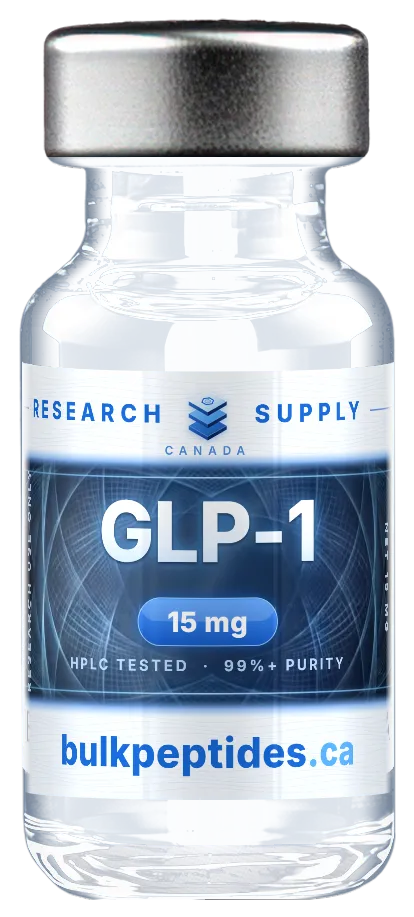
- The coloured cap and aluminium crimp seal on a vial. Our vials carry no printed batch number, so the cap and crimp colour is how a vial is matched to its certificate on the COAs page.
Buying from us
- Strength
- The labelled amount of compound in a vial, stated in milligrams, for example 10mg. It refers to the whole vial contents, of which net peptide content is a proportion.
- Volume break
- A published discount that applies automatically once your cart holds enough vials, in any mix of products: 5% at two to three, 15% at four to six, 25% at seven to nine and 35% at ten or more.
- Research use only (RUO)
- The legal basis on which these compounds are sold: for in vitro laboratory research and analytical work, not for use in people or animals. Nothing on this site is medical advice or guidance on use.
All products supplied by Bulk Peptides are for laboratory research use only and are not approved for human consumption, clinical, or veterinary use.