
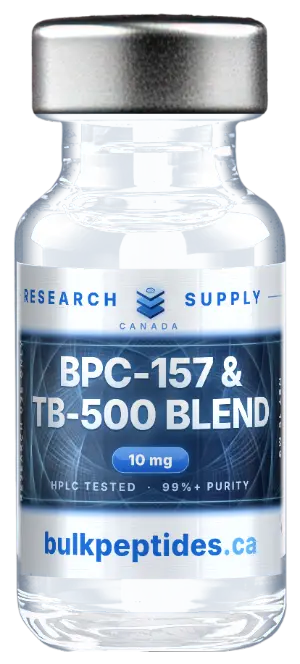
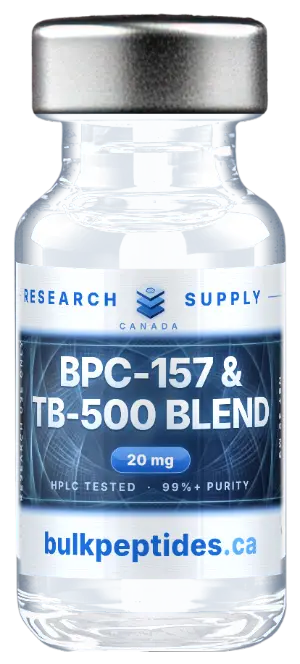
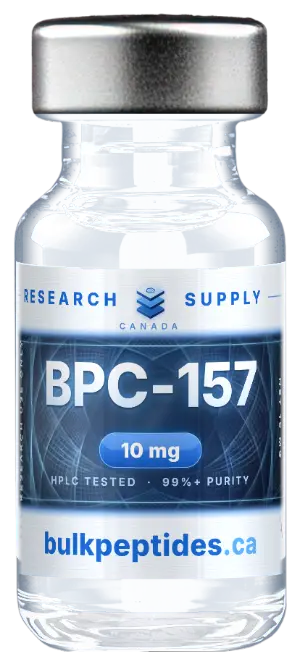
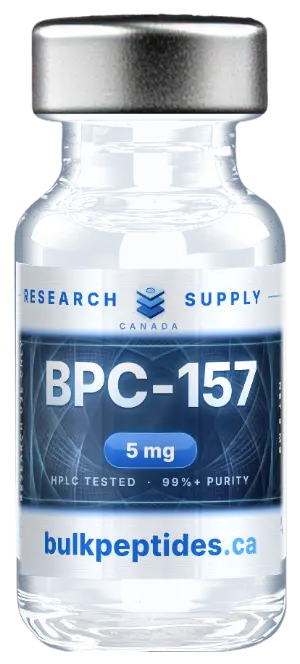
Sourcing BPC-157 and TB-500 in Canada for a multi-vial study? This category stocks both compounds as single-peptide vials and as fixed-ratio combinations, shipped as freeze-dried powder from within Canada, strictly for laboratory research use only. The two names usually travel together, yet structurally they share nothing: separate origins, very different chain lengths and distinct mechanisms proposed in the literature.
Ordering BPC-157 and TB-500 in Canada by volume
- BPC-157 — 5 mg or 10 mg vials
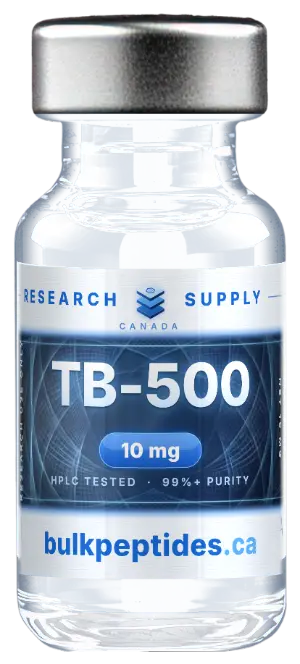
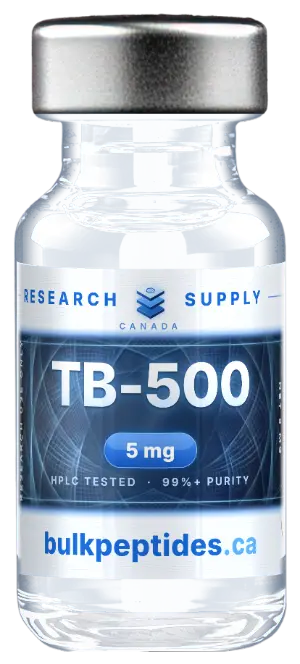
- TB-500 — 5 mg or 10 mg vials
- Combined vial, 10 mg total (5 mg of each compound)
- Combined vial, 20 mg total (10 mg of each compound)
- Larger multi-peptide blends that pair both with GHK-Cu
Blend listings state each component's mass, because the headline figure on a combined vial reveals nothing about the quantity of either compound inside. Single vials and blends can be mixed in one cart toward the volume tiers on our bulk pricing page.
Telling the two compounds apart
BPC-157
A 15-residue peptide (pentadecapeptide) with the sequence GEPPPGKPADDAGLV, formula C62H98N16O22, roughly 1,419.5 g/mol, CAS 137525-51-0. Published work characterises it as a fragment taken from a sequence found in a gastric protein. Three prolines sit together mid-chain, which matters for chromatography: the peptide bond ahead of each proline flips between cis and trans slowly compared with the time scale of a reverse-phase HPLC run, so the main peak tends to widen. A broadened or shouldered peak is expected behaviour for this molecule, not a sign that something else is in the vial.
TB-500
TB-500 and thymosin beta-4 are not interchangeable, although suppliers mix them up regularly. TB-500 is the acetylated seven-residue fragment matching positions 17–23 of thymosin beta-4 — C38H68N10O14, near 889 g/mol, CAS 885340-08-9. The full-length protein has 43 residues and weighs about 4,963 g/mol. The mass reported on the certificate is the check that separates them; our explainer on TB-500 versus full thymosin beta-4 walks through it, and the TB-500 Canada page covers ordering the fragment in quantity.
Limits of the published evidence
For both molecules the literature is extensive at the cell-culture and animal-model level, while controlled human data are close to non-existent. No regulator, in Canada or elsewhere, has granted either one a market authorisation. The useful question is which models were used and what they can support — our review of the BPC-157 literature and its limits walks through the study designs.
Testing, vial matching and storage
Products are third-party tested for HPLC purity. Where a certificate has been published it appears on the COAs page unedited, in the form the lab released it, and each vial is tied to its certificate by cap and crimp colour — handy when logging a multi-vial delivery into inventory. Both compounds ship dry because the lyophilised form holds up far better than a solution; see stability of lyophilised peptides in storage and how impurities arise in synthetic peptides.
For laboratory research only — not for human or veterinary use. These materials hold no Health Canada or FDA authorisation, carry neither a DIN nor an NPN, and are not produced under pharmaceutical GMP.