

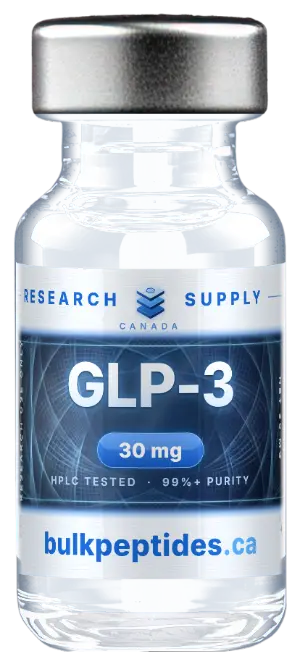
Labs sourcing incretin peptides in Canada will find GLP-1, GIP and glucagon receptor compounds here, shipped as freeze-dried powder, strictly for laboratory research use only. Products in this class can look alike on a shelf while differing sharply in regulatory position, so please read the status section below before placing an order.
Receptor coverage: one, two or three targets
All three receptors in play belong to class B of the G-protein-coupled receptor family: GLP-1, GIP and glucagon. What separates the molecules here is how many of those receptors each one acts on, and in what proportion:
- Single agonists — the GLP-1 receptor only.
- Dual agonists — GLP-1 plus GIP.
- Triple agonists — GLP-1, GIP and glucagon.
For these compounds, the balance of activity across receptors is the core design variable. Published ratios also move with the assay behind them: a ratio of binding affinities and a ratio of functional potencies measure different things, and one cannot be substituted for the other. We explain why in GLP-1, GIP and glucagon receptor pharmacology and Ki versus IC50 versus EC50.
Regulatory status of incretin peptides in Canada
No product in this category is authorised in Canada for human or veterinary use. None has a Drug Identification Number or a Natural Product Number, none is made under pharmaceutical Good Manufacturing Practice, and none comes with any sterility or endotoxin assurance. Supply is for laboratory research only; the full framework is set out in our article on how research peptides are regulated in Canada.
Why chain length complicates QC
These are long molecules — the triple agonists reach 39 residues and exceed 4,700 g/mol — and that has analytical consequences. Each additional residue means another synthesis step and another chance of a deletion sequence. Losing one internal residue from a 39-mer shifts the mass by only a small fraction, which a low-resolution instrument may fail to resolve. Several compounds in this class also carry fatty-acid or linker modifications, and those largely govern how they are retained on a column.
The practical takeaway for QC staff: HPLC area purity promises less here than it does for short peptides, and confirming identity by mass carries more weight — a point worth remembering when comparing suppliers on cost per milligram. Related reading: sources of peptide impurities and what a per-milligram price leaves out.
Receiving and certificates
Products are third-party tested; certificates that have been published are on the COAs page unaltered from the lab's version, and cap and crimp colour matches each vial to its certificate. Orders leave from within Canada as lyophilised powder. Multi-vial orders count toward the bulk pricing tiers.
For laboratory research only — not for human or veterinary use. In this presentation these materials hold no Health Canada or FDA authorisation for research supply, carry neither a DIN nor an NPN, and are not produced under pharmaceutical GMP.