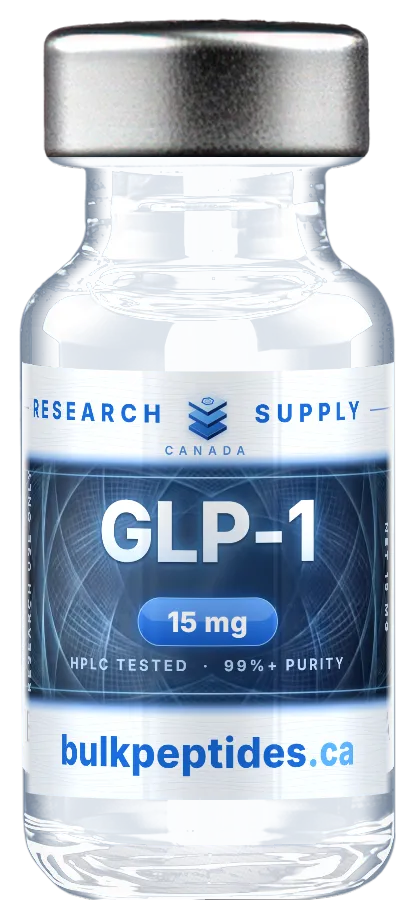
Our GLP-1, GLP-2 and GLP-3 listings are the highest-value vials in the catalogue, which makes the volume ladder matter more here than anywhere else: the 35% step on a ten-vial order of these peptides is measured in hundreds of dollars, and the choice of fill size shifts the per-milligram price in a way the smaller compounds do not. This guide explains how the three listings are defined, prices all ten vials in Canadian dollars at list and at the 10+ tier, works through single-compound and mixed ten-vial orders, and covers domestic dispatch, payment, published certificates for tested lots and the questions to put to any supplier of this class.
Three listings, defined by receptor target
The names are ours and they describe receptor activity, not a specific published molecule. GLP-1 is a research peptide that targets the GLP-1 receptor. GLP-2 is a dual incretin-receptor agonist, acting at the GLP-1 and GIP receptors. GLP-3 adds the glucagon receptor to those two, making it a triple agonist. Each listing’s product page carries the identity data its certificate should be checked against, and the incretin and glucagon category groups all ten vials. When comparing with another supplier, compare on the receptor profile and the certificate’s observed mass, not on a product name, because names in this class are not standardised between vendors.
The fills are GLP-1 10 mg, 15 mg and 20 mg; GLP-2 10 mg, 15 mg and 20 mg; and GLP-3 10 mg, 15 mg, 20 mg and 30 mg.
All ten vials at list and at 10+
Catalogue prices on 22 November 2026, in Canadian dollars. The 10+ columns show each vial once an order holds ten or more vials of any product.
| Product | List price (CAD) | Per mg at list | Per vial at 10+, applied automatically | Per mg at 10+ |
|---|---|---|---|---|
| GLP-1 10 mg | $210.99 | $21.10 | $137.14 | $13.71 |
| GLP-1 15 mg | $294.99 | $19.67 | $191.74 | $12.78 |
| GLP-1 20 mg | $378.99 | $18.95 | $246.34 | $12.32 |
| GLP-2 10 mg | $173.99 | $17.40 | $113.09 | $11.31 |
| GLP-2 15 mg | $252.99 | $16.87 | $164.44 | $10.96 |
| GLP-2 20 mg | $326.99 | $16.35 | $212.54 | $10.63 |
| GLP-3 10 mg | $168.99 | $16.90 | $109.84 | $10.98 |
| GLP-3 15 mg | $241.99 | $16.13 | $157.29 | $10.49 |
| GLP-3 20 mg | $326.99 | $16.35 | $212.54 | $10.63 |
| GLP-3 30 mg | $441.99 | $14.73 | $287.29 | $9.58 |
Within each listing the larger fill is cheaper per milligram, and the 30 mg GLP-3 vial is the lowest per-milligram figure in the class at $9.58 at the 10+ tier. Between listings, GLP-1 is priced above GLP-2 and GLP-3 at every size. A lab deciding between a 10 mg and a 20 mg fill is deciding between a smaller open vial and a lower per-milligram price; the ladder then applies on top of whichever it picks.
What ten vials cost, three ways
Ten GLP-3 10 mg vials at the 10+ tier cost $1,098.40 for 100 mg, against a list total of $1,689.90. Ten GLP-1 20 mg vials cost $2,463.40 for 200 mg, a $1,326.50 reduction on list. And a mixed order of four GLP-1 10 mg, three GLP-2 10 mg and three GLP-3 10 mg makes ten vials at $1,217.35 for 100 mg across the three listings, every vial priced at 35% off because the count is taken across the cart. At the other end of the ladder, two GLP-2 15 mg vials sit in the 5% tier at $480.68. On vials of this price the distance between the first step and the last is large, and an order that lands at seven, eight or nine vials is nearly always worth taking to ten. Beyond a few cases the ladder gives way to an individual quote, as the bulk pricing page explains.
Mixing the class with the rest of the shop
Every vial in the cart counts toward the tier. Three GLP vials with seven vials of anything else reach the 35% tier, and the discount applies to the GLP vials as much as to the others. For a lab whose main spend is in this class, that means the cheaper compounds it also uses can be added to the same order without diluting the tier, and the whole quarter’s material arrives in one tracked parcel. The price list shows the per-milligram figure for every product in the catalogue, which is the quickest way to plan the mix.
Dispatch from inside Canada
Orders leave from Canadian stock within one business day, tracked and plainly packaged, to Canadian addresses only; an order after the daily cut-off is sent with the following day’s parcels, and a Friday-evening order goes out on Monday. Delivery is free on any order over $200 CAD, which a single vial from this class clears at list. No parcel crosses a border, so there is no duty, no brokerage and no customs hold, and for vials of this value the absence of a border inspection is worth as much as the absence of a brokerage invoice. The shipping page covers regional transit, holidays that differ by province and delivery to institutional receiving docks.
Payment
Interac e-Transfer, credit card, cryptocurrency and Apple Pay on Apple devices are the methods. Interac is the usual one: place the order, send the exact total from your bank using the instructions on the confirmation screen, and the order is released once the transfer is matched. Card payments are charged in US dollars at the live rate, which on an order of this size is worth noting when reconciling the statement. Bitcoin, Ethereum and Solana are accepted. The cart total does not change with the method. Institutions that need a quote or an invoice with a purchase order number can arrange it through the order desk, as the payment methods page describes.
Certificates for this class
We publish certificates for tested lots on the certificates page, from independent laboratories, reproduced as issued. These are long peptides, and a certificate should give an observed mass that matches the calculated mass on the product page for that listing; a match to a different peptide of the same family is not confirmation of identity. The HPLC purity figure should be given with its detection wavelength and, for a molecule of this size, a method with a shallow enough gradient to resolve closely related impurities. Net peptide content should be stated, since the labelled milligrams include counter-ion and water and the difference on a 20 mg or 30 mg vial is not small. Our notes on what an HPLC area-percent figure measures and on measuring how much of a vial is peptide explain the two figures a buyer in this class leans on most.
Our vials carry no printed lot number; each is matched to its certificate by cap and crimp colour against the photographs on the report, and on a ten-vial delivery that check belongs in the receiving record for every vial. A certificate describes the tested lot, not necessarily the lot shipping on the day, and new certificates are added as testing returns. The purity guarantee covers an unused vial that misses its stated specification on independent testing.
What to ask any supplier of these peptides
Start with definitions, because this is the class where names mislead most: which receptors does the supplier say the material targets, and does the certificate’s observed mass match a molecule with that profile? Then the document: which laboratory issued it, can it be verified on that laboratory’s site, as our verification guide shows for ours, and how is the vial linked to it? Then the terms: where the parcel ships from, the currency of the price, who pays any charge at the door, and what happens if an independent test disagrees. The choosing a supplier page expands every item.
Frequently asked questions
Do the three listings count together toward the 10+ tier?
Yes, and so does everything else in the shop. Any ten vials reach the tier, and the discount applies to each of them.
Which fill is cheapest per milligram?
Within each listing the largest fill: 20 mg for GLP-1 and GLP-2, 30 mg for GLP-3. Across the class, GLP-3 30 mg is the lowest at the 10+ tier.
Are GLP-1, GLP-2 and GLP-3 the names used by other suppliers?
Not necessarily. Our names describe receptor activity. Compare on the receptor profile and the certificate’s observed mass rather than on a name.
Can we order more than a few cases?
Yes. Beyond the ladder we quote individually and can schedule deliveries; the wholesale page lists what to include in the request.
Related pages
The incretin and glucagon category lists all ten vials, the price list compares them per milligram with the rest of the catalogue, and the where-to-buy index links the other guides in this series.
All products are sold for laboratory research use only and are not for human or animal use.