Description
Larger fills tend to prompt a closer look at the paperwork. Here is what the certificate for a long multi-receptor peptide does and does not tell you.
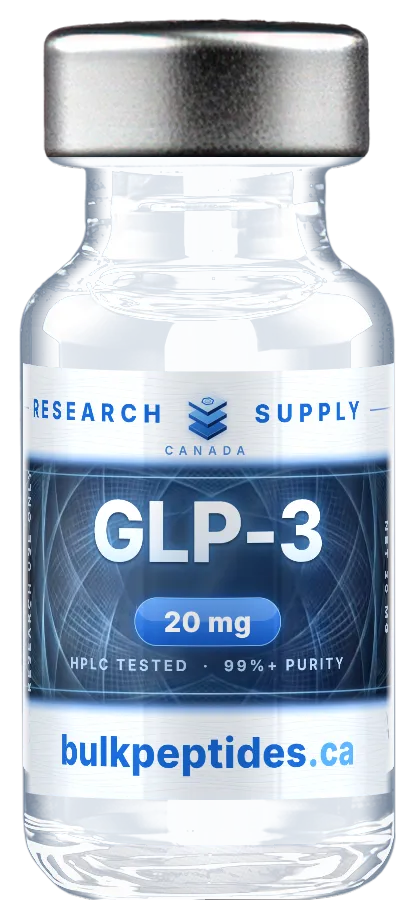
GLP-3 20 mg and reading its certificate
The HPLC purity figure is the share of the detected signal in the main peak under the stated conditions. For a long peptide, the nearby small peaks are usually related substances, such as sequences one residue short or forms that have lost an amide, and a good method resolves them. Our specification is 99%+, and third-party results typically land between 99.7% and 99.9%.
What the purity figure does not report is net peptide content: the fraction of the powder’s weight that is peptide rather than counter-ions or residual water. The two are separate measurements, and both are worth understanding before converting the mass on the label into a molar concentration.
Receptor profile and specification
| Compound class | Triple GLP-1, GIP and glucagon receptor agonist peptide |
|---|---|
| Target receptors | GLP-1R, GIPR and GCGR (class B GPCRs) |
| Primary functional readout | Gs-coupled cAMP accumulation in receptor-expressing cells |
| Vial content | 20 mg |
| Physical form | Lyophilised powder in a sealed vial |
| Analysis | Third-party HPLC and purity testing to a 99%+ specification; certificates are posted on our COAs page |
| Supplied for | Laboratory research use only |
Questions about GLP-3 20mg
What are the small peaks near the main peak?
Usually related substances such as truncated or deamidated sequences, resolved by the HPLC method.
Is HPLC purity the same as net peptide content?
No. Purity describes the peptide signal; net content describes how much of the powder’s mass is peptide.
Where is the certificate?
On our COAs page, matched to the vial by cap and crimp colour.
Certificates for our compounds are posted on the certificates of analysis page and matched to vials by cap and crimp colour. If the one for this product is not up yet, contact the order desk.
Related research compounds
Browse more compounds in Incretin & Glucagon Peptides, or view the full research peptide catalogue.
Supplied for laboratory research use only. Not for human or veterinary use.