This index collects our buying guides for research peptides in Canada, one for each compound or compound group a Canadian lab is likely to order by the case. Every guide is written from the same position: the useful question is not what one vial costs but what a programme’s worth of material costs once it is on the bench, in Canadian dollars, with nothing owed at the door. Each guide prices our vials at list and at the 10+ tier, works through a ten-vial order and a mixed cart, and covers domestic dispatch, payment by Interac e-Transfer, published certificates for tested lots and the questions to put to any supplier.
The guides
- Where to buy BPC-157 in Canada: two single-compound vials and two TB-500 blends, a ten-vial order of the 10 mg fill priced out, and why a mixed cart reaches the top tier without ten of any one product.
- Where to buy TB-500 in Canada: which molecule the name refers to in our vials, a seven-vial against ten-vial comparison, and what a certificate for a short acetylated fragment should confirm.
- Where to buy GHK-Cu in Canada: the 50 mg and 100 mg fills, what a gram costs in one order, and the two halves of a certificate for a copper complex.
- Where to buy CJC-1295 and ipamorelin in Canada: ten singles against ten blends for a lab that uses both, and what a two-peptide certificate has to show.
- Where to buy sermorelin and tesamorelin in Canada: a 29-residue vial against a 44-residue one, a ten-vial order split across both, and how to tell the two analogues apart on a certificate.
- Where to buy PT-141 in Canada: one of the lowest per-milligram figures in the catalogue at the 10+ tier, and why a cyclic peptide’s observed mass is the first thing to check.
- Where to buy KLOW and GLOW blends in Canada: what the label total contains, a blend vial priced against its components at the same tier, and what a three- or four-component certificate must identify.
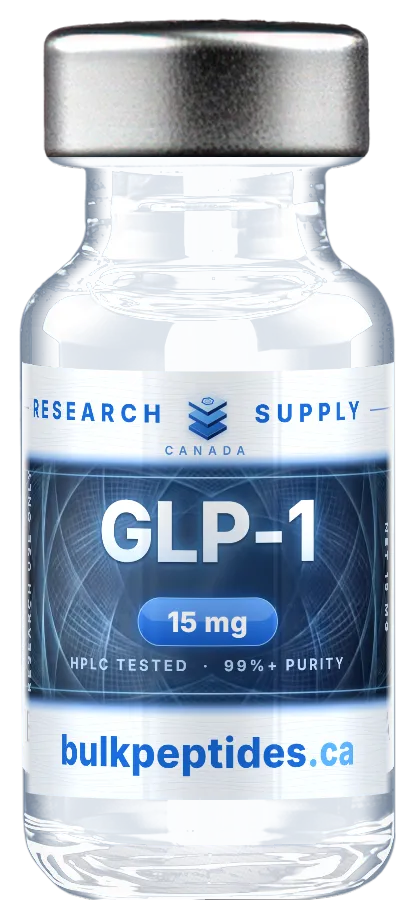
- Where to buy GLP-1, GLP-2 and GLP-3 research peptides in Canada: how the three listings are defined by receptor target, all ten fills priced at list and 10+, and why names in this class are not a basis for comparison.
What every guide has in common
The volume ladder is the same for every product in the shop and it is counted across the whole order: one vial at list, 5% off each vial at two or three, 15% at four to six, 25% at seven to nine, and 35% at ten or more, applied in the cart with no code and no account. Because the count is taken across everything in the order, ten vials of ten different compounds are priced the same way as ten vials of one. The guides therefore spend as much time on mixed carts as on single-compound cases, since that is how most labs actually order. Past a few cases the ladder stops and we price the order individually; the bulk pricing page explains the ladder and the wholesale page explains the quote.
Dispatch is the second constant. Every order starts inside Canada and goes to a Canadian address, tracked and plainly packaged, within one business day of confirmation. There is no customs form, no duty and no brokerage bill, and orders over $200 CAD ship free to every province and territory, which covers every order at the 10+ tier. The shipping page has the policy.
Payment is the third. Interac e-Transfer is the method most Canadian labs use with us; credit cards are charged in US dollars at the live rate; Bitcoin, Ethereum and Solana are accepted; and Apple Pay is available on Apple devices. The total in the cart is the total you pay by any of them. The payment methods page walks through each.
Testing is the fourth. We publish certificates for tested lots on the certificates page, issued by independent laboratories and reproduced as issued, and our vials are matched to their certificates by cap and crimp colour rather than by a printed lot number. A certificate describes the tested lot, not necessarily the lot shipping on the day, and new ones are added as testing comes back. The purity guarantee covers an unused vial that misses its stated specification when you have it tested independently.
Reading a per-milligram figure
Each guide divides the vial price by the labelled milligrams to give a per-milligram figure at list and at the 10+ tier. Two cautions apply to every such number, ours included. The labelled milligrams are gross: the lyophilised powder includes counter-ion and residual water, and the net peptide content on the certificate is the figure that converts a vial into a quantity of peptide. And a per-milligram comparison between two suppliers only holds when both are selling the same molecule in the same form, which is why the TB-500 guide starts with which fragment is in the vial and the GLP guide starts with receptor definitions rather than names. The price list gives the per-milligram figure for every product in the catalogue on one page.
Before ordering from anyone
The choosing a supplier page is the full checklist. The short form that runs through every guide is five questions. Is the testing laboratory named on the certificate, and will that laboratory confirm the report on its own site? How is the vial in your hand tied to the report, by printed lot number or by photograph? What wavelength was the purity figure measured at, and is the observed mass compared with the right calculated mass for that molecule? What does the supplier do if your own independent test disagrees with its certificate? And where does the parcel ship from, in which currency is the price set, and who pays any charge at the door? Our answers to those questions for our own products are on the is Bulk Peptides legit page and in the certificate verification guide.
Compounds without a guide yet
The rest of the catalogue is covered by the compound hubs rather than a buying guide for now: MOTS-c, epitalon and selank and semax each have a hub page, and the research peptides Canada page lists every province and city page alongside the full set of hubs. Pricing, dispatch, payment and certificates work the same way for every product, so the sections above apply to those compounds too.
All products are sold for laboratory research use only and are not for human or animal use.