A certificate of analysis is only worth something if you can confirm that the laboratory named on it issued it, and that the vial on your bench is the one it describes. This page explains how to do both for the reports we publish: where they live, how each laboratory lets you check its own report, what the fields mean, how a vial is tied to its lot, and what no certificate can tell you.
Where our certificates are published
Every report we hold is posted on the certificates of analysis page as an image card. Opening a card shows the full-resolution document, including the chromatogram and the laboratory’s own verification details, exactly as the laboratory issued it. We copy results as printed and do not edit, crop or summarise a laboratory’s figures.
We publish certificates for tested lots. A compound can be in stock before its report has come back, so a missing card means no report has been posted for it yet. If the one you need is not there, write to the order desk with the compound and strength and we will tell you where it stands.
Three laboratories, three ways to check
So far our certificates come from ILS Laboratories, Janoshik Analytical and Chromate. Each prints a different identifier on its report and keeps its own route for confirming that a document is one it issued. The route is printed on the report itself, so you never have to take our word for where to look.
Janoshik Analytical: task number and unique key
A Janoshik document is headed “Test Report” and carries a task number near the top, written with a hash sign. Below the signature line it reads “Verify this test at www.janoshik.com/verify/ with the following unique key”, followed by a string of letters and numbers. Enter that key on the laboratory’s verification page, character for character, and the laboratory shows its own record of the test. Compare the task number, dates, result rows and purity figure with the image on our page. A QR code beside the results table opens the same check from a phone.
ILS Laboratories: certificate number and access code
An ILS certificate is headed “Certificate of Analysis” and lists a COA number in the form COA-year-code, together with a lot number, the labelled content, the analysis date, the date the sample was received and the method run. The access code sits twice on the page: beneath the QR code in the top right corner, next to the words “Scan to verify authenticity”, and again in the footer beside the COA number and the address of the laboratory’s portal. Scanning the code, or entering the access code at the portal address printed on the certificate, brings up the laboratory’s copy of the document for comparison.
Chromate: report number and access code
A Chromate document is headed “Report of Analysis” with the report number and an access code printed side by side at the top. The footer repeats the report number and access code alongside the address of the laboratory’s verify page and a QR code. Enter the access code there and compare what comes back with the image we have posted, field by field.
What each field on a report means
The three laboratories lay their documents out differently, but the fields worth reading are the same on each.
| Field | What it tells you |
|---|---|
| Task, COA or report number | The laboratory’s own reference for the job. It is the number you quote back to the laboratory and the one that must match between our image and the laboratory’s record. |
| Key or access code | The credential that unlocks the laboratory’s copy. If it is missing, or the laboratory’s site does not recognise it, treat the document as unverified. |
| Dates | When testing was ordered, when the sample arrived and when the analysis was run. A result describes the material on the analysis date, not the material in perpetuity. |
| Client | Who submitted the sample. Some laboratories record this as “Anonymous” at the client’s request; that is a feature of the laboratory’s process, not a defect in the report. |
| Product and labelled content | The compound name and the milligram figure on the label of the vial submitted. This is the line that must agree with the label on the vial you received. |
| Method | The technique used, usually reversed-phase HPLC with UV detection for purity, and the reference used for identity where that was tested. A purity figure cannot be reproduced without the method and conditions. |
| Identity | Whether the main peak was confirmed as the named compound, typically by retention-time comparison with a reference standard. Purity only has meaning once identity is settled. |
| Purity | The share of the total detected signal in the main peak, expressed as a percentage. Our specification is 99%+ and the figure here is the one to compare with it. |
| Quantity or net content | The milligrams of compound the laboratory measured in the vial. It is a separate measurement from purity and can sit above or below the label figure. |
| Chromatogram | The trace behind the number. One main peak on a flat baseline supports the purity figure; the retention time labelled on the peak is the value used for identity. |
| Notes and methodology | Where a laboratory sets out how purity was calculated, any cap on the reported figure and what the certificate does not cover. |
Matching the vial on your bench to the report
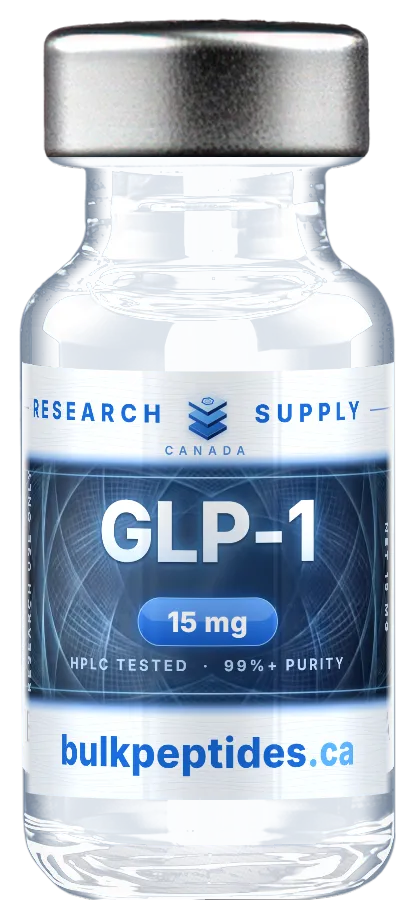
Our vials do not carry a printed lot number. A vial is matched to its certificate by cap and crimp colour: the colour of the flip-off cap and of the crimp seal beneath it identify the lot, and where a laboratory photographed the sample it tested, that photograph appears on its certificate and shows the colours to look for. On receipt, set each vial beside the posted certificate for its compound and strength, check that the label text agrees with the product line on the report, and record the laboratory, the report number and the key or access code in your receiving log.
If more than one certificate is posted for the same compound and strength, or you want written confirmation of which report covers a particular order, write to the order desk with your order number. Keeping that note with your lab records means material used months later can be traced back to the same result.
What a certificate does not prove
A verified report proves that the named laboratory analysed a sample and reported the figures shown. It is worth being clear about what it does not establish.
- It does not speak for every vial in a lot. A laboratory tests the sample it was sent; the result is representative of the lot, not a measurement of each unit.
- It does not cover tests that were not run. An HPLC purity report says nothing about endotoxin, sterility, heavy metals or water content unless those rows appear on it.
- It does not fix a purity figure for all time. Results describe the material on the analysis date, stored as the laboratory received it.
- It does not compare directly with a report from another laboratory run under different conditions. Column, gradient, wavelength and integration all move an area-percent figure by small amounts, which is why the conditions are printed.
- It is not a statement about fitness for any use. Our material is sold for laboratory research only, and a certificate describes analytical identity and purity, nothing more.
If something does not match
If the laboratory’s record differs from our image in any field, if the key or access code is not recognised, or if the cap and crimp colours on your vial do not agree with the report, stop and contact the order desk with the order number, the report number and a photograph of the vial. We will find out what has happened and tell you. If you prefer to have a vial analysed by a laboratory of your own choosing, the purity guarantee sets out what we do when an independent result falls below our specification, including the refund of your testing fees.
The terms used on certificates, from area-percent purity to net peptide content and counter-ion, are defined in our peptide glossary.
All products are sold for laboratory research use only and are not for human or animal use.