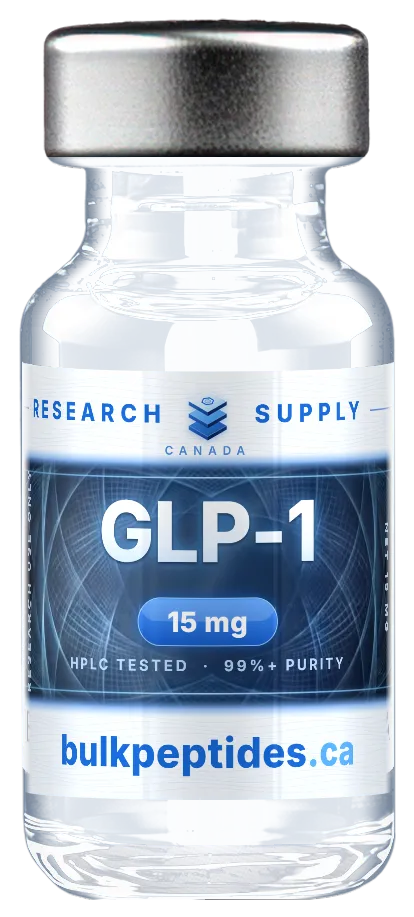
Net Peptide Content: How Much Peptide Is Really in the Vial
Two quotes for “10 mg” of the same peptide can hold noticeably different amounts of actual peptide, and neither supplier is necessarily cutting corners. The gap comes from what else shares the vial with the molecule: counter-ions left over from purification, water held by the freeze-dried cake, and traces of solvent. Net peptide content is the figure that accounts for all of it. For a lab ordering in volume, it affects every concentration calculated from the powder and every cost comparison made between lots or suppliers. This article explains what the number means, how it is measured, and how to use it.
Three numbers that describe one vial
A certificate can carry three different quantities, and they answer three different questions.
| Figure | Question it answers | What it ignores |
|---|---|---|
| Label or gross weight | How much powder is in the vial? | Composition of that powder |
| HPLC purity | Of the peptide present, what share is the target sequence? | Counter-ions, water, solvents |
| Net peptide content | What share of the powder’s mass is peptide at all? | Which peptide species that is |
The common mistake is to treat HPLC purity as if it answered the third question. It does not. A lot can be 99% pure by HPLC and around 75% peptide by mass, and both statements are accurate.
What makes up the non-peptide mass
Counter-ions
Peptides with basic groups, such as lysine, arginine, histidine and a free N-terminus, carry positive charges that must be balanced. Reversed-phase purification with trifluoroacetic acid leaves trifluoroacetate as the partner ion, and each one adds roughly 114 Da. Material exchanged to the acetate form carries a lighter counter-ion of about 60 Da per charge. The more basic sites a sequence has, the larger this share becomes. More on this in TFA and acetate salt forms.
Water
Freeze-dried peptide is hygroscopic and holds bound water even when handled well. The amount rises each time a vial is opened in humid air. See Karl Fischer titration for peptides for how it is measured.
Residual solvent
Small amounts of acetonitrile or acetic acid can remain from purification and drying. They are usually minor, but they contribute to gross mass all the same.
Taken together, these typically put net peptide content somewhere in the region of 70 to 90 percent of powder weight, with heavily basic sequences toward the lower end.
How net peptide content is measured
Several approaches exist, and a certificate should say which one was used.
- Amino acid analysis. The sample is hydrolysed to its free amino acids, which are then quantified against standards. Because it counts the building blocks directly, it gives absolute peptide mass regardless of salts or water, and it is widely treated as the reference method.
- Elemental nitrogen analysis. Total nitrogen is measured and converted to peptide mass using the sequence’s known nitrogen content. It is quicker, but nitrogen-containing impurities or counter-ions can bias it.
- Mass balance. Water by Karl Fischer and counter-ion by ion chromatography are measured separately and subtracted from 100 percent, with any residual solvent also accounted for.
- UV absorbance. For sequences with tryptophan or tyrosine, absorbance at 280 nm and a calculated extinction coefficient give concentration in solution, which can be traced back to the powder.
Correcting a stock concentration
Suppose an analytical stock is prepared from a 10 mg vial whose certificate reports net peptide content of 80 percent and HPLC purity of 98 percent. The vial holds about 8.0 mg of peptide, of which about 7.8 mg is the target sequence. Dissolved in 2.00 mL, the stock is roughly 4.0 mg/mL of peptide, not the 5.0 mg/mL the label weight implies. That is a 25 percent overstatement if left uncorrected.
To work in molar units, divide the corrected mass concentration by the molecular weight of the free peptide, not the salt. Whether to correct for purity as well as net content depends on the assay; many labs correct for both when impurities could plausibly interfere.
The key point is that this error is systematic. Replicates will not reveal it, averaging will not remove it, and it shifts every derived value such as EC50s or standard curves by the same factor. Two labs that handle it differently will not get comparable results.
Using the figure when comparing quotes and lots
For procurement, net peptide content turns a label weight into something comparable. The useful basis is cost per milligram of actual peptide: price divided by label mass multiplied by the net content fraction. Two offers with the same label weight and the same price are not equivalent if one lot is 85 percent peptide and the other 70 percent.
It matters between lots from a single source as well. When a lab moves from one lot to the next partway through a study, a change in net content changes the true concentration of stocks made the same way. Recording the figure for each lot in the inventory, next to the lot number and the vial’s cap and crimp colour, lets the lab adjust calculations rather than discover the shift in its data.
When the certificate does not report it
- Ask for it. Suppliers sometimes hold the data even when the standard report omits it.
- Commission it. Contract labs offer amino acid analysis, and it is worth the cost for quantitative work on a large lot, since one result covers every vial from that lot.
- Quantify the solution. UV at 280 nm works for suitable sequences and gives a direct concentration.
- State the assumption. If you proceed on label weight, note it in the methods so readers can judge the uncertainty.
Bulk Peptides’ products are tested by a third-party laboratory for HPLC purity. Certificates for some products are on our certificates of analysis page, each vial’s cap and crimp colour links it to its certificate, and where the one for your lot is not posted, we can send what we have on file.
The calculations here are for in-vitro and analytical laboratory stocks. Bulk Peptides supplies research compounds that are not intended for use in humans or animals.