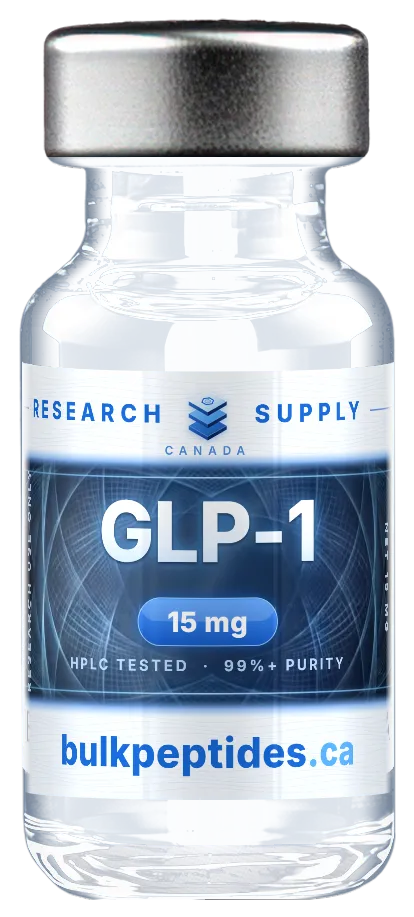
Wholesale Peptides in Canada: Comparing True Cost per Milligram
Anyone sourcing wholesale peptides in Canada eventually lines up two supplier listings side by side and tries to decide which one is cheaper. The shelf price rarely answers that. A vial label states a nominal fill mass, not the quantity of intact target sequence inside, and two vials with identical labels can hold noticeably different amounts of usable compound. For a lab buying dozens of vials a quarter, the honest figure is cost per milligram of correct peptide, delivered to your door. This article walks through how a procurement lead or QC reviewer can build that number, which inputs to request from a supplier, and how multi-vial pricing changes the arithmetic.
Why the sticker on a vial is a weak comparison tool
A listing price bundles several things you cannot see: how much of the powder is actually peptide, how much of that peptide is the right sequence, whether the lot was independently analysed, and what it costs to get the box through to your receiving dock. Two listings can differ on every one of those points while showing labels that look interchangeable.
The practical consequence is simple. Dividing price by the number on the label gives you cost per nominal milligram, which is a marketing unit. Dividing by milligrams of target compound gives you a purchasing unit. Only the second one is safe to put in a budget or a supplier comparison memo.
From label mass to milligrams of peptide
Freeze-dried research peptides are not pure free peptide. Purification by reversed-phase chromatography typically leaves the material as a salt, very often with trifluoroacetate or acetate as the counter-ion. The dried cake also holds on to some water, because peptides readily absorb moisture. Everything in the vial therefore falls into three buckets: the peptide itself, the counter-ions paired with its charged groups, and residual moisture.
The share that is genuinely peptide is called net peptide content. It is usually determined by amino acid analysis or a nitrogen-based method rather than by HPLC, and for many research peptides it lands roughly in the 70 to 90 percent band. Sequences with many basic residues tend to carry more counter-ion mass, so they often sit toward the lower end.
To convert, multiply the label mass by the net content fraction. A vial labelled 5 mg with a reported net content of 75 percent holds about 3.75 mg of peptide. If a supplier cannot give you a net content figure, record the effective quantity as unknown rather than assuming the label is the answer.
Adding purity to the calculation
Net content and HPLC purity measure different things, and both reduce the amount of useful material. Net content tells you how much of the powder is peptide. Purity tells you what fraction of that peptide is the intended sequence, as opposed to truncated chains, deletion sequences, oxidised forms or other synthesis by-products.
Because they act independently, you multiply them. The working formula looks like this:
- Target compound (mg) = label mass × net peptide content × HPLC purity
- Effective cost per mg = landed price of the vial ÷ target compound (mg)
Take two vials both labelled 5 mg. One reports 72 percent net content and 96 percent purity, giving about 3.46 mg of target compound. The other reports 88 percent and 99 percent, giving about 4.36 mg. The second vial contains roughly a quarter more usable material, even though the two labels match exactly. Price them identically and the second one is clearly the better buy; price the first one a little lower and it can still lose.
Mix-and-match volume pricing on wholesale peptides in Canada
Volume pricing is where bulk buying changes the picture. Many suppliers apply their breaks per product, so a lab only reaches a better tier by ordering a large count of a single compound. That structure rewards over-ordering one item and penalises a varied research programme.
Bulk Peptides uses mix-and-match volume pricing instead: every vial in the cart counts toward the volume break, whatever the compound or size. For a lab that needs a few vials each of several peptides, that means the order is priced on its total vial count, not on how many of any one item it contains.
When you compare suppliers, model the order you actually plan to place rather than a single vial:
- List every compound and vial size your group expects to use over the ordering period.
- Apply each supplier’s break structure to that complete basket, noting whether breaks are per product or across the whole cart.
- Recalculate effective cost per mg for each line using the discounted vial price.
- Add the landed-cost items below, spread across the full order.
Consolidating purchases into fewer, larger orders also cuts receiving work. One delivery means one inspection, one set of certificates to file and, where the supplier can manage it, fewer lot numbers to track across the shelf.
Landed cost versus listed cost
A foreign listing and a Canadian listing are only comparable once both are converted to the amount that actually leaves your account. For an imported order, add:
- Exchange-rate conversion at your card or bank rate, which is usually worse than the published mid-market rate.
- International shipping, plus any surcharge for insulated or expedited packaging.
- Duties and taxes assessed at the border by the CBSA.
- Courier brokerage fees, often billed on delivery and easy to forget in a quote.
- The operational cost of delay if a parcel is held for inspection while planned work waits.
A domestic order avoids the border steps. It carries the GST or HST that applies in the delivery province, with no import duty or brokerage, and transit time is shorter, which matters for cold-chain planning in summer heat or a prairie winter. Once those items are included, an import that looked cheaper per vial frequently ends up close to, or above, the domestic figure.
Blends: price each component, not the total
A blended vial can look like excellent value simply because its total mass is large. The comparison only works if you know how that mass divides between components. A 20 mg blend that is half one peptide and half another supplies 10 mg of each; it is not equivalent to a 20 mg single-compound vial of either.
Ask for the per-component masses, and ask whether purity is reported separately for each peak. Then apply the same formula to each component on its own. If the split is not stated, the per-milligram cost of any one component cannot be worked out.
A comparison sheet your procurement team can reuse
A standard worksheet keeps comparisons consistent across quotes and reorders. The columns below cover the inputs discussed above:
| Column | What to record |
|---|---|
| Compound and vial size | Name, label mass, and for blends the per-component split |
| Net peptide content | Reported value and method, or “not supplied” |
| HPLC purity | Value, detection wavelength and lot number from the certificate |
| Testing | Third-party or in-house, and whether a certificate is available for the lot |
| Volume break | Per product or whole cart, and the tier your planned order reaches |
| Landed price | Vial price after discount, plus shipping, taxes, duty and brokerage |
| Effective cost per mg | Landed price divided by milligrams of target compound |
Where a column cannot be completed, leave it visibly blank. A gap in the sheet is useful information about a supplier. Bulk Peptides products are third-party tested for purity by HPLC, certificates are published for some products on the certificates of analysis page, and vials are matched to their certificate by cap and crimp colour, which makes the testing column straightforward to fill in at receiving.
All material discussed here is sold for in-vitro laboratory research only. It is not for human or veterinary use, and nothing in this article is guidance on use.
For standing orders and quantities beyond the cart tiers, see wholesale peptide supply in Canada.