Description
TB-500 is sold under a name that suggests the full thymosin beta-4 protein, but the material in this vial is a short synthetic fragment. Knowing exactly which molecule you are ordering is the first step in reading any result it produces.
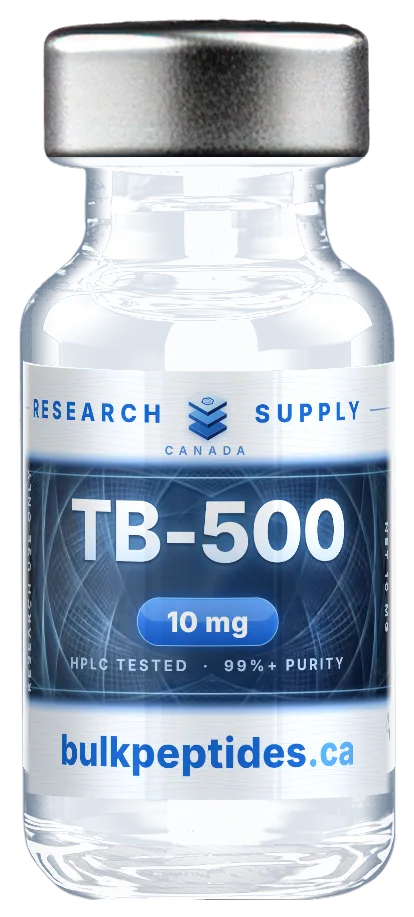
TB-500 10 mg: the actin-binding motif in a larger vial
The sequence is Ac-Leu-Lys-Lys-Thr-Glu-Thr-Gln, residues 17 to 23 of thymosin beta-4 with an acetylated N-terminus. That stretch contains the LKKTET motif the full protein uses to bind monomeric actin, which is why the fragment turns up in cytoskeleton and cell-motility research. Its molecular mass is 889.0 g/mol, far smaller than the 4.9 kDa parent protein.
The 10 mg format suits labs running repeated scratch-wound or migration assays, where a single vial can supply a whole series of plates. Pairing it with BPC-157 is common enough that we also stock pre-combined blends, but many groups prefer separate vials so each compound can be added to an assay independently.
Compound identity and specification
| Compound | TB-500 |
|---|---|
| Sequence | Ac-Leu-Lys-Lys-Thr-Glu-Thr-Gln (acetylated LKKTETQ, the thymosin beta-4 17-23 region) |
| Molecular formula | C38H68N10O14 |
| Molecular mass | 889.0 g/mol |
| CAS registry number | 885340-08-9 |
| PubChem | CID 62707662 |
| Vial content | 10 mg |
| Physical form | Lyophilised powder in a sealed vial |
| Analysis | Third-party HPLC and purity testing to a 99%+ specification; certificates are posted on our COAs page |
| Supplied for | Laboratory research use only |
Questions about TB-500 10mg
Is TB-500 the same as thymosin beta-4?
No. It is a seven-residue synthetic fragment of the 43-residue protein. Treat literature on the full protein and on the fragment as separate bodies of work.
Why is the N-terminus acetylated?
Acetylation mirrors the native protein’s N-terminal cap and removes a free amine, which changes charge and can improve stability against exopeptidases in culture media.
Does TB-500 10 mg qualify for quantity breaks?
Yes. Two or more vials start the breaks, and ten vials in the cart, TB-500 or any mix, take 35% off each.
Research literature
Peer-reviewed studies involving this compound and its class. All findings listed are from in vitro, cell culture or animal models and are provided for scientific reference only. This product is supplied for laboratory research and is not approved for human consumption, clinical, or veterinary use.
- Bock-Marquette I, et al. Nature. 2004;432(7016):466-472. In embryonic mouse cardiomyocyte and endothelial culture and a mouse coronary artery ligation model, measured cell migration, myocyte survival and ILK/Akt kinase activity. Source · PMID 15565145
- Malinda KM, et al. FASEB J. 1997;11(6):474-481. In human umbilical vein endothelial cell (HUVEC) culture, measured directional chemotactic migration in Boyden-chamber assays. Source · PMID 9194528
- Philp D, et al. FASEB J. 2003;17(14):2103-2105. In HUVEC culture and chick aortic arch explants, measured migration, adhesion and vessel sprouting elicited by the LKKTETQ actin-binding motif at approximately 50 nM. Source · PMID 14500546
Literature notes: Published work concerns full-length thymosin beta-4 or its LKKTETQ actin-binding fragment. Equivalence between those and material marketed as TB-500 is not established in the literature.
Certificates for our compounds are posted on the certificates of analysis page and matched to vials by cap and crimp colour. If the one for this product is not up yet, contact the order desk.
Related research compounds
Browse more compounds in BPC-157 & TB-500 Peptides, or view the full research peptide catalogue.
Supplied for laboratory research use only. Not for human or veterinary use.