Description
GLOW combines two of the most widely studied peptides in the catalogue, BPC-157 and TB-500, with the copper tripeptide GHK-Cu. It exists for labs that were already buying all three.
GLOW 70 mg: three components, one vial
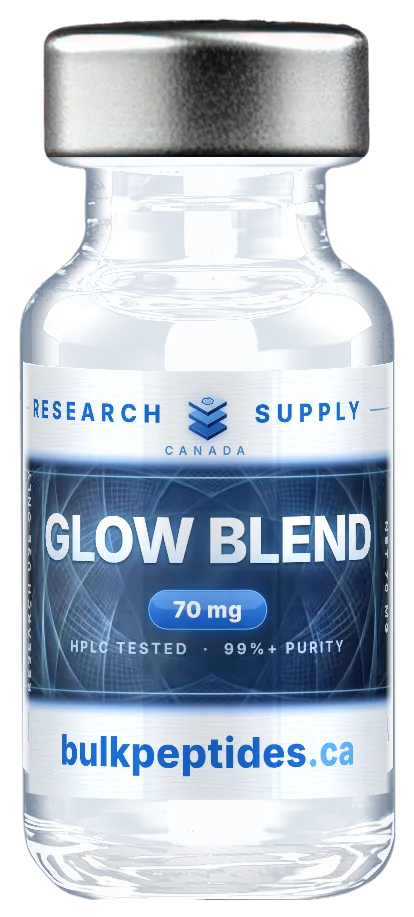
The vial holds 10 mg of BPC-157, 10 mg of TB-500 and 50 mg of GHK-Cu. The copper complex dominates by mass and gives the powder its blue colour. On HPLC the three components separate well, since they differ widely in size and charge: GHK-Cu is a tripeptide, TB-500 a heptapeptide and BPC-157 fifteen residues long.
Because each component can be bought separately, the blend makes sense only when this fixed ratio is what an experiment needs. The identity table below lists each molecule so all three can be recorded against the vial’s cap and crimp colour.
Compound identity and specification
| Component | Sequence | Formula | Mass (g/mol) | CAS |
|---|---|---|---|---|
| BPC-157 CID 9941957 | Gly-Glu-Pro-Pro-Pro-Gly-Lys-Pro-Ala-Asp-Asp-Ala-Gly-Leu-Val (GEPPPGKPADDAGLV) | C62H98N16O22 | 1419.5 | 137525-51-0 |
| TB-500 CID 62707662 | Ac-Leu-Lys-Lys-Thr-Glu-Thr-Gln (acetylated LKKTETQ, the thymosin beta-4 17-23 region) | C38H68N10O14 | 889.0 | 885340-08-9 |
| GHK-Cu CID 73587 | Gly-His-Lys, supplied as the copper(II) complex | C14H24N6O4 (free tripeptide); C14H23CuN6O4 as the copper complex | 340.38 free tripeptide; 402.92 as the copper complex | 49557-75-7 (GHK); 89030-95-5 (copper tripeptide-1) |
Questions about GLOW Peptide Blend 70mg
What is in GLOW?
10 mg BPC-157, 10 mg TB-500 and 50 mg GHK-Cu, for 70 mg in total.
How does GLOW differ from KLOW?
KLOW adds 10 mg of KPV, the Lys-Pro-Val tripeptide, to the same three components.
Why is the blend blue?
The GHK-Cu copper complex is blue, and it makes up most of the mass.
Research literature
Peer-reviewed studies involving this compound and its class. All findings listed are from in vitro, cell culture or animal models and are provided for scientific reference only. This product is supplied for laboratory research and is not approved for human consumption, clinical, or veterinary use.
- Chang CH, et al. J Appl Physiol. 2011;110(3):774-780. In rat Achilles tendon explant culture and isolated tendon fibroblasts, measured explant outgrowth, fibroblast survival under oxidative stress, migration, and FAK/paxillin phosphorylation. Source · PMID 21030672
- Hsieh MJ, et al. J Mol Med (Berl). 2017;95(3):323-333. In chick chorioallantoic membrane assay, a rat hind-limb ischaemia model and human endothelial cell culture, measured vessel density, endothelial tube formation and VEGFR2-Akt-eNOS phosphorylation. Source · PMID 27847966
- Chang CH, et al. Molecules. 2014;19(11):19066-19077. In primary tendon fibroblasts from Sprague-Dawley rat Achilles tendon, measured growth hormone receptor mRNA and protein levels, PCNA expression and JAK2 phosphorylation. Source · PMID 25415472
- Bock-Marquette I, et al. Nature. 2004;432(7016):466-472. In embryonic mouse cardiomyocyte and endothelial culture and a mouse coronary artery ligation model, measured cell migration, myocyte survival and ILK/Akt kinase activity. Source · PMID 15565145
- Malinda KM, et al. FASEB J. 1997;11(6):474-481. In human umbilical vein endothelial cell (HUVEC) culture, measured directional chemotactic migration in Boyden-chamber assays. Source · PMID 9194528
- Philp D, et al. FASEB J. 2003;17(14):2103-2105. In HUVEC culture and chick aortic arch explants, measured migration, adhesion and vessel sprouting elicited by the LKKTETQ actin-binding motif at approximately 50 nM. Source · PMID 14500546
- Maquart FX, et al. FEBS Lett. 1988;238(2):343-346. In cultured fibroblasts, measured collagen synthesis rates in response to the GHK-Cu2+ complex. Source · PMID 3169264
- Simeon A, et al. Life Sci. 2000;67(18):2257-2265. In fibroblast culture, measured matrix metalloproteinase-2 expression and activity by zymography after GHK-Cu2+ exposure. Source · PMID 11045606
- Simeon A, et al. J Invest Dermatol. 2000;115(6):962-968. In rat dermal fibroblast culture and a rodent in vivo model, measured glycosaminoglycan levels and decorin and biglycan mRNA. Source · PMID 11121126
Literature notes: The published base for this compound is small and concentrated in a limited number of research groups, with little independent replication of in vivo findings. Published work concerns full-length thymosin beta-4 or its LKKTETQ actin-binding fragment. Equivalence between those and material marketed as TB-500 is not established in the literature.
Certificates for our compounds are posted on the certificates of analysis page and matched to vials by cap and crimp colour. If the one for this product is not up yet, contact the order desk.
Related research compounds
Browse more compounds in Multi-Peptide Blends, or view the full research peptide catalogue.
Supplied for laboratory research use only. Not for human or veterinary use.