Description
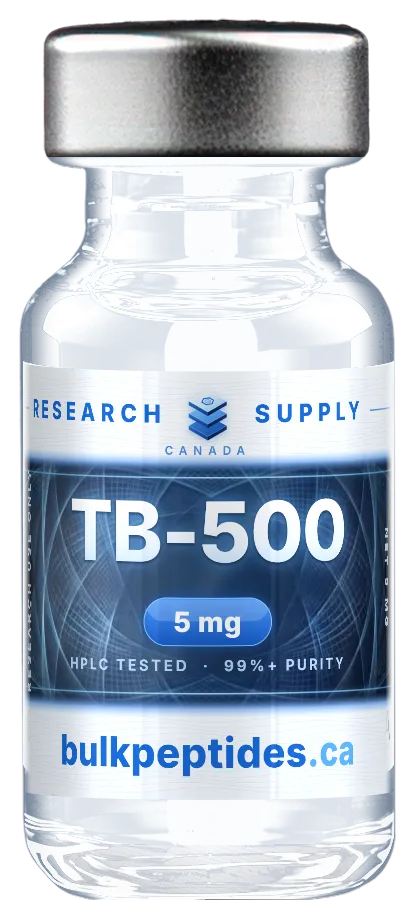
If a lab has not worked with TB-500 before, the 5 mg vial is the low-commitment way to check how the fragment behaves in its own buffers and assays before scaling up.
TB-500 5 mg for first experiments
Chemically, TB-500 is small and basic: two lysines give the heptapeptide a positive charge at physiological pH, and the acetyl cap on leucine removes the N-terminal amine. It dissolves readily in aqueous buffer and elutes early on most reversed-phase gradients, so it is worth confirming its retention time on your own system before relying on it as a reference.
Because it represents only the actin-binding stretch of thymosin beta-4, experiments with TB-500 are usually designed to isolate that one interaction. Smaller vials make it easier to run the fragment alongside the full protein or a scrambled control without over-ordering either.
Compound identity and specification
| Compound | TB-500 |
|---|---|
| Sequence | Ac-Leu-Lys-Lys-Thr-Glu-Thr-Gln (acetylated LKKTETQ, the thymosin beta-4 17-23 region) |
| Molecular formula | C38H68N10O14 |
| Molecular mass | 889.0 g/mol |
| CAS registry number | 885340-08-9 |
| PubChem | CID 62707662 |
| Vial content | 5 mg |
| Physical form | Lyophilised powder in a sealed vial |
| Analysis | Third-party HPLC and purity testing to a 99%+ specification; certificates are posted on our COAs page |
| Supplied for | Laboratory research use only |
Questions about TB-500 5mg
How long does a sealed 5 mg vial keep?
Unopened and dry, lyophilised peptide keeps best frozen at around minus 20 °C, away from light. Once dissolved, stability depends on buffer and storage, so plan to use material promptly.
What purity should I expect?
Our specification is 99%+ by HPLC, and third-party results typically come in between 99.7% and 99.9%.
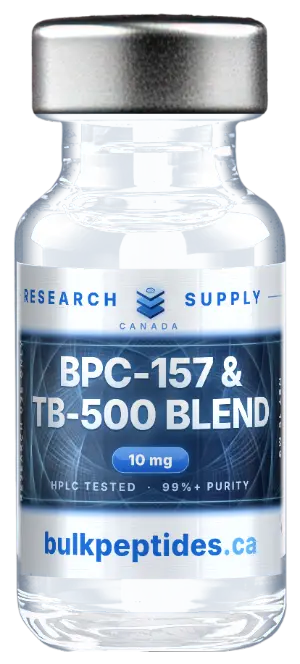
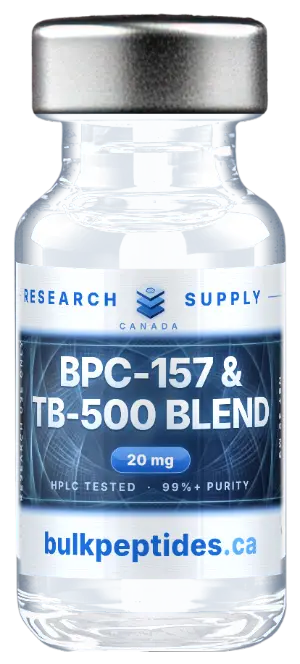
Is there a blend with BPC-157?
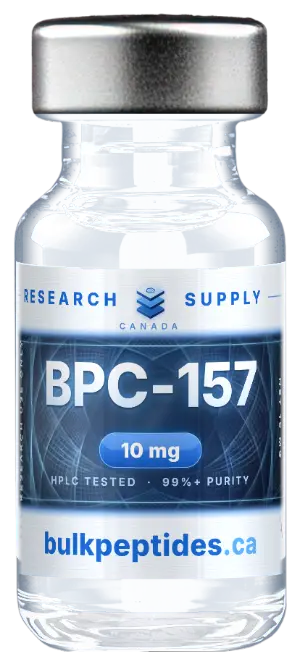
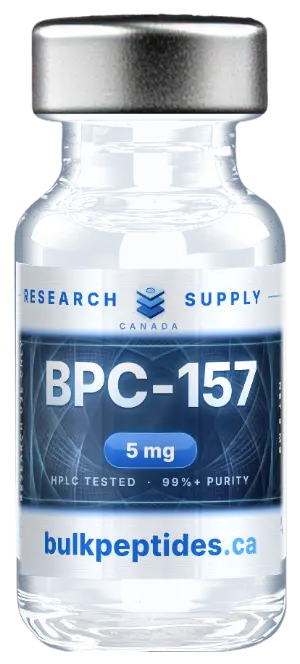
Yes, in 10 mg and 20 mg totals. Separate vials give more control over ratios; the blends save a step where a fixed ratio is wanted.
Research literature
Peer-reviewed studies involving this compound and its class. All findings listed are from in vitro, cell culture or animal models and are provided for scientific reference only. This product is supplied for laboratory research and is not approved for human consumption, clinical, or veterinary use.
- Bock-Marquette I, et al. Nature. 2004;432(7016):466-472. In embryonic mouse cardiomyocyte and endothelial culture and a mouse coronary artery ligation model, measured cell migration, myocyte survival and ILK/Akt kinase activity. Source · PMID 15565145
- Malinda KM, et al. FASEB J. 1997;11(6):474-481. In human umbilical vein endothelial cell (HUVEC) culture, measured directional chemotactic migration in Boyden-chamber assays. Source · PMID 9194528
- Philp D, et al. FASEB J. 2003;17(14):2103-2105. In HUVEC culture and chick aortic arch explants, measured migration, adhesion and vessel sprouting elicited by the LKKTETQ actin-binding motif at approximately 50 nM. Source · PMID 14500546
Literature notes: Published work concerns full-length thymosin beta-4 or its LKKTETQ actin-binding fragment. Equivalence between those and material marketed as TB-500 is not established in the literature.
Certificates for our compounds are posted on the certificates of analysis page and matched to vials by cap and crimp colour. If the one for this product is not up yet, contact the order desk.
Related research compounds
Browse more compounds in BPC-157 & TB-500 Peptides, or view the full research peptide catalogue.
Supplied for laboratory research use only. Not for human or veterinary use.