Description
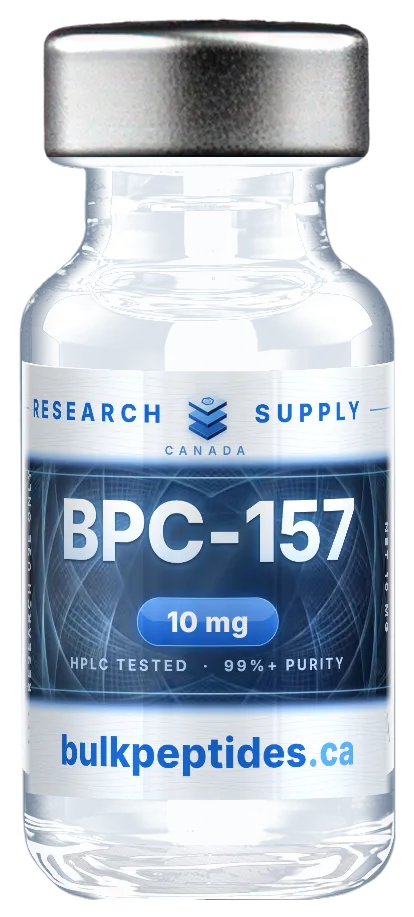
The 10 mg vial is the format to standardise on once a BPC-157 protocol is settled: twice the material of the 5 mg format, one label, one certificate to match, and a lower cost per milligram before any quantity break is applied.
BPC-157 10 mg for longer study runs
BPC-157 is a synthetic pentadecapeptide whose sequence was taken from a larger protein first described in gastric juice. It carries no disulphide bridges and no unusual residues, which makes it straightforward to characterise: a single main peak by reversed-phase HPLC and a molecular mass of 1419.5 g/mol. Four of its fifteen residues are proline, and that proline-rich stretch is usually credited for its unusual stability in solution compared with other short peptides.
In the published literature it appears mainly as a tool in cell-culture and animal-model work on endothelial and fibroblast signalling, with readouts such as FAK and paxillin phosphorylation or VEGFR2 activity. Labs running those assays across several weeks tend to prefer the larger vial because every well in a series can be drawn from the same material.
Compound identity and specification
| Compound | BPC-157 |
|---|---|
| Sequence | Gly-Glu-Pro-Pro-Pro-Gly-Lys-Pro-Ala-Asp-Asp-Ala-Gly-Leu-Val (GEPPPGKPADDAGLV) |
| Molecular formula | C62H98N16O22 |
| Molecular mass | 1419.5 g/mol |
| CAS registry number | 137525-51-0 |
| PubChem | CID 9941957 |
| Vial content | 10 mg |
| Physical form | Lyophilised powder in a sealed vial |
| Analysis | Third-party HPLC and purity testing to a 99%+ specification; certificates are posted on our COAs page |
| Supplied for | Laboratory research use only |
Questions about BPC-157 10mg
How many 10 mg vials qualify for a quantity break?
Any two vials in the cart drop the price 5%, four 15%, seven 25% and ten 35%, and they do not have to be the same product. The break is applied in the cart automatically; larger runs can be quoted.
How do I tell this vial apart from the 5 mg format on the bench?
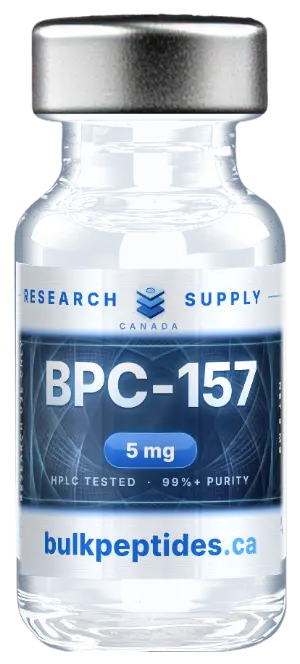
The strength is printed on the label band, and the cap and crimp colour ties the vial to its certificate. Record both when the parcel is logged.
Is BPC-157 supplied as a salt?
It is supplied as lyophilised peptide. The certificate states the analytical method used; net peptide content, where reported, accounts for counter-ions and residual water.
Research literature
Peer-reviewed studies involving this compound and its class. All findings listed are from in vitro, cell culture or animal models and are provided for scientific reference only. This product is supplied for laboratory research and is not approved for human consumption, clinical, or veterinary use.
- Chang CH, et al. J Appl Physiol. 2011;110(3):774-780. In rat Achilles tendon explant culture and isolated tendon fibroblasts, measured explant outgrowth, fibroblast survival under oxidative stress, migration, and FAK/paxillin phosphorylation. Source · PMID 21030672
- Hsieh MJ, et al. J Mol Med (Berl). 2017;95(3):323-333. In chick chorioallantoic membrane assay, a rat hind-limb ischaemia model and human endothelial cell culture, measured vessel density, endothelial tube formation and VEGFR2-Akt-eNOS phosphorylation. Source · PMID 27847966
- Chang CH, et al. Molecules. 2014;19(11):19066-19077. In primary tendon fibroblasts from Sprague-Dawley rat Achilles tendon, measured growth hormone receptor mRNA and protein levels, PCNA expression and JAK2 phosphorylation. Source · PMID 25415472
Literature notes: The published base for this compound is small and concentrated in a limited number of research groups, with little independent replication of in vivo findings.
Certificates for our compounds are posted on the certificates of analysis page and matched to vials by cap and crimp colour. If the one for this product is not up yet, contact the order desk.
Related research compounds
Browse more compounds in BPC-157 & TB-500 Peptides, or view the full research peptide catalogue.
Supplied for laboratory research use only. Not for human or veterinary use.