Description
NAD+ sits in our catalogue because research groups working on peptides so often work on cellular metabolism too, but it is a small-molecule coenzyme and should be handled as one.
NAD+ 500 mg: a coenzyme, not a peptide
Nicotinamide adenine dinucleotide is two nucleotides joined through their phosphate groups: nicotinamide mononucleotide and adenosine monophosphate. Its oxidised form, NAD+, accepts electrons in hundreds of redox reactions and is consumed as a substrate by sirtuins and PARP enzymes. The formula is C21H27N7O14P2 and the mass 663.4 g/mol.
It absorbs strongly at 260 nm because of its adenine ring, which makes HPLC with UV detection a natural fit for purity checks. The solid is hygroscopic, so moisture is the main enemy; keep the vial closed until it has reached room temperature to stop condensation forming inside.
Compound identity and specification
| Compound | NAD+ |
|---|---|
| Sequence | Not a peptide: nicotinamide adenine dinucleotide, a dinucleotide of nicotinamide mononucleotide and adenosine monophosphate |
| Molecular formula | C21H27N7O14P2 |
| Molecular mass | 663.4 g/mol |
| CAS registry number | 53-84-9 |
| PubChem | CID 5892 |
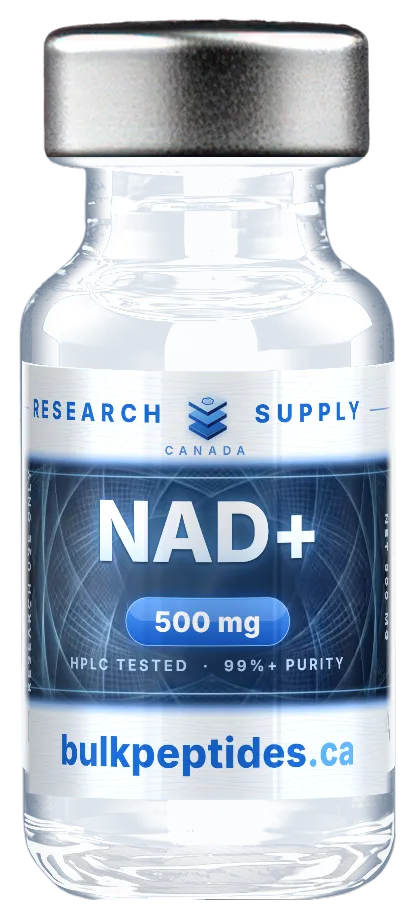
| Vial content | 500 mg |
| Physical form | Lyophilised powder in a sealed vial |
| Analysis | Third-party HPLC and purity testing to a 99%+ specification; certificates are posted on our COAs page |
| Supplied for | Laboratory research use only |
Questions about NAD+ 500mg
Is NAD+ a peptide?
No. It is a dinucleotide coenzyme. The identity table below says so explicitly.
Why let the vial warm up before opening?
Cold solid pulls moisture from the air. Opening a vial at room temperature prevents condensation on a hygroscopic material.
Is there a larger fill?
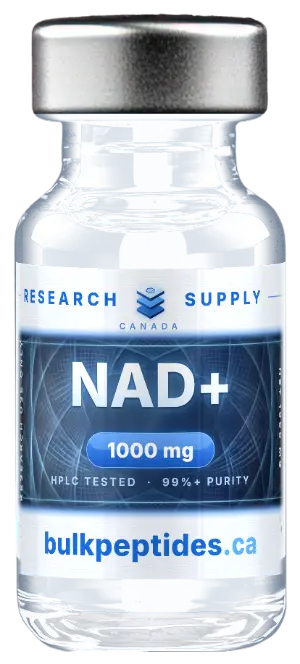
Yes, 1000 mg, which lowers the cost per milligram for labs using NAD+ routinely.
Research literature
Peer-reviewed studies involving this compound and its class. All findings listed are from in vitro, cell culture or animal models and are provided for scientific reference only. This product is supplied for laboratory research and is not approved for human consumption, clinical, or veterinary use.
- Canto C, et al. Cell Metab. 2012;15(6):838-847. In mammalian cells and mouse skeletal muscle and brown adipose tissue, measured tissue NAD+ levels and SIRT1/SIRT3 target deacetylation. Source · PMID 22682224
- Gomes AP, et al. Cell. 2013;155(7):1624-1638. In aged mouse skeletal muscle, measured nuclear NAD+ decline, normoxic HIF-1alpha accumulation and loss of mtDNA-encoded OXPHOS subunits. Source · PMID 24360282
- Mills KF, et al. Cell Metab. 2016;24(6):795-806. In C57BL/6N mice over 12 months, measured tissue NAD+ synthesis, cellular energetics, insulin sensitivity and skeletal-muscle mitochondrial oxidative capacity. Source · PMID 28068222
Literature notes: These studies concern NAD+ precursors (nicotinamide riboside and nicotinamide mononucleotide) rather than NAD+ administered directly.
Certificates for our compounds are posted on the certificates of analysis page and matched to vials by cap and crimp colour. If the one for this product is not up yet, contact the order desk.
Related research compounds
Browse more compounds in Mitochondrial & Cellular Compounds, or view the full research peptide catalogue.
Supplied for laboratory research use only. Not for human or veterinary use.