Description
Most peptides in our catalogue come from genes in the cell nucleus. MOTS-c is different: its short open reading frame sits inside the mitochondrial 12S rRNA gene.
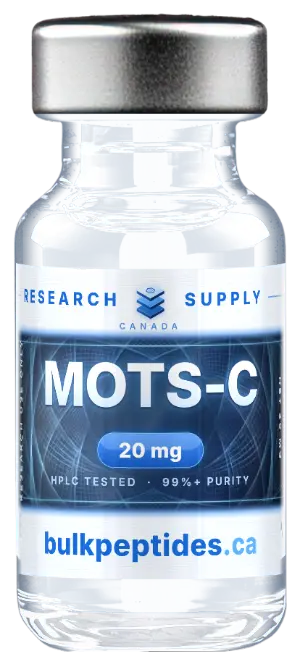
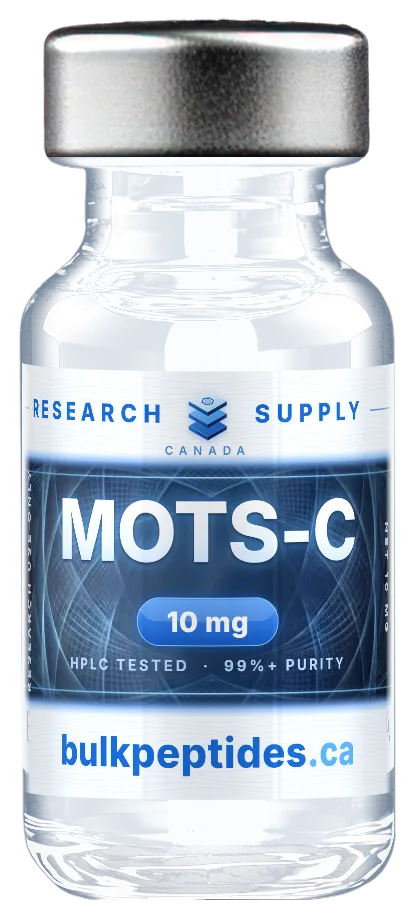
MOTS-c 10 mg, a peptide encoded in mitochondrial DNA
Described in 2015, MOTS-c is sixteen residues long, Met-Arg-Trp-Gln-Glu-Met-Gly-Tyr-Ile-Phe-Tyr-Pro-Arg-Lys-Leu-Arg, with a mass of 2174.6 g/mol. Two methionines and a tryptophan make it sensitive to oxidation, and four basic residues give it a strong positive charge, which affects both its chromatography and how it behaves in cell media.
Research use centres on cellular energy sensing, particularly AMPK signalling, and on how a mitochondrially encoded peptide can act elsewhere in the cell. The 10 mg vial is sized for cell-culture studies; the 20 mg fill suits longer programmes.
Compound identity and specification
| Compound | MOTS-c |
|---|---|
| Sequence | Met-Arg-Trp-Gln-Glu-Met-Gly-Tyr-Ile-Phe-Tyr-Pro-Arg-Lys-Leu-Arg |
| Molecular formula | C101H152N28O22S2 |
| Molecular mass | 2174.6 g/mol |
| CAS registry number | 1627580-64-6 |
| PubChem | CID 146675088 |
| Vial content | 10 mg |
| Physical form | Lyophilised powder in a sealed vial |
| Analysis | Third-party HPLC and purity testing to a 99%+ specification; certificates are posted on our COAs page |
| Supplied for | Laboratory research use only |
Questions about MOTS-c 10mg
Where does the name MOTS-c come from?
Mitochondrial Open reading frame of the Twelve S rRNA type-c, describing where its coding sequence lies.
Why protect MOTS-c from air?
Its methionines and tryptophan oxidise readily. Keep the powder sealed, cold and dry until use.
How do the 10 mg and 20 mg vials differ?
Only in fill. The 20 mg vial is cheaper per milligram and means fewer vials to track.
Research literature
Peer-reviewed studies involving this compound and its class. All findings listed are from in vitro, cell culture or animal models and are provided for scientific reference only. This product is supplied for laboratory research and is not approved for human consumption, clinical, or veterinary use.
- Lee C, et al. Cell Metab. 2015;21(3):443-454. In mouse skeletal muscle and cultured cells, measured inhibition of the folate-methionine cycle and de novo purine biosynthesis with consequent AMPK activation. Source · PMID 25738459
- Kim KH, et al. Cell Metab. 2018;28(3):516-524. In cultured human cells under receptor-signalling stress, measured AMPK-dependent nuclear translocation and occupancy at antioxidant-response-element genes. Source · PMID 29983246
- Reynolds JC, et al. Nat Commun. 2021;12:470. In young, middle-aged and old CD-1 and C57BL/6 mice, measured running capacity, grip strength, gait and skeletal-muscle transcriptomic profiles. Source · PMID 33473109
Certificates for our compounds are posted on the certificates of analysis page and matched to vials by cap and crimp colour. If the one for this product is not up yet, contact the order desk.
Related research compounds
Browse more compounds in Mitochondrial & Cellular Compounds, or view the full research peptide catalogue.
Supplied for laboratory research use only. Not for human or veterinary use.