Description
AOD-9604 is a piece of growth hormone rather than a hormone in its own right. It keeps a short stretch of the C-terminus and nothing of the region that binds the growth hormone receptor.
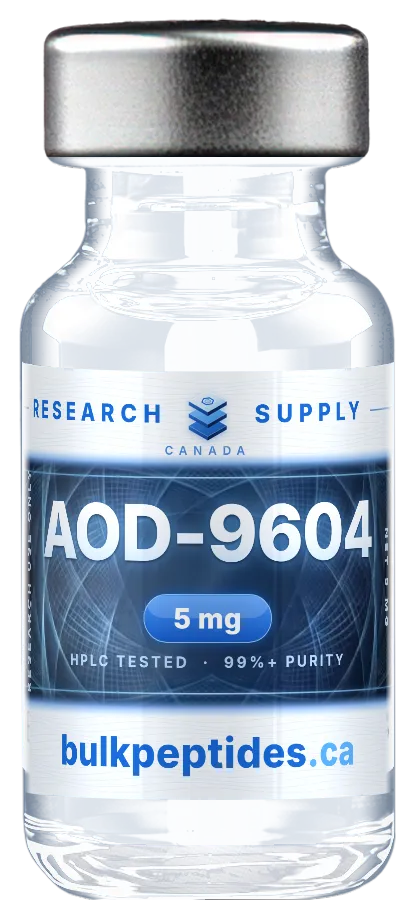
AOD-9604 5 mg, a C-terminal growth hormone fragment
The sequence is residue 177 to 191 of human growth hormone with an added N-terminal tyrosine, for a formula of C78H123N23O23S2 and a mass of 1815.1 g/mol. The two sulphurs belong to cysteines that can form an intramolecular disulphide, so its HPLC behaviour depends partly on redox state; the certificate records the conditions used.
In the literature it is studied mainly in adipocyte culture and animal models to separate the effects of this fragment from those of intact growth hormone. It is supplied here strictly as a research reference compound.
Compound identity and specification
| Compound | AOD-9604 |
|---|---|
| Sequence | Tyr followed by the human growth hormone 177-191 fragment |
| Molecular formula | C78H123N23O23S2 |
| Molecular mass | 1815.1 g/mol |
| CAS registry number | 221231-10-3 |
| PubChem | CID 71300630 |
| Vial content | 5 mg |
| Physical form | Lyophilised powder in a sealed vial |
| Analysis | Third-party HPLC and purity testing to a 99%+ specification; certificates are posted on our COAs page |
| Supplied for | Laboratory research use only |
Questions about AOD-9604 5mg
Does AOD-9604 bind the growth hormone receptor?
It lacks the receptor-binding regions of growth hormone, which is the reason it is used to study the C-terminal fragment on its own.
Why does the formula contain sulphur?
The fragment includes two cysteines, which can be linked by a disulphide bridge.
How is AOD-9604 stored?
Lyophilised and frozen, protected from light and moisture, like the rest of the catalogue.
Research literature
Peer-reviewed studies involving this compound and its class. All findings listed are from in vitro, cell culture or animal models and are provided for scientific reference only. This product is supplied for laboratory research and is not approved for human consumption, clinical, or veterinary use.
- Heffernan M, et al. Endocrinology. 2001;142(12):5182-5189. In wild-type and beta3-adrenergic receptor knockout mice, measured beta3-AR mRNA expression, establishing receptor dependency. Source · PMID 11713213
- Ng FM, et al. Horm Res. 2000;53(6):274-278. In a Zucker rat model, characterised ex vivo receptor-pathway activity; see the linked record for methods and endpoints. Source · PMID 11146367
Literature notes: Papers concerning the related analog AOD-9401 are sometimes miscited as AOD-9604 work; the references above concern AOD-9604 specifically.
Certificates for our compounds are posted on the certificates of analysis page and matched to vials by cap and crimp colour. If the one for this product is not up yet, contact the order desk.
Related research compounds
Browse more compounds in GHS, or view the full research peptide catalogue.
Supplied for laboratory research use only. Not for human or veterinary use.