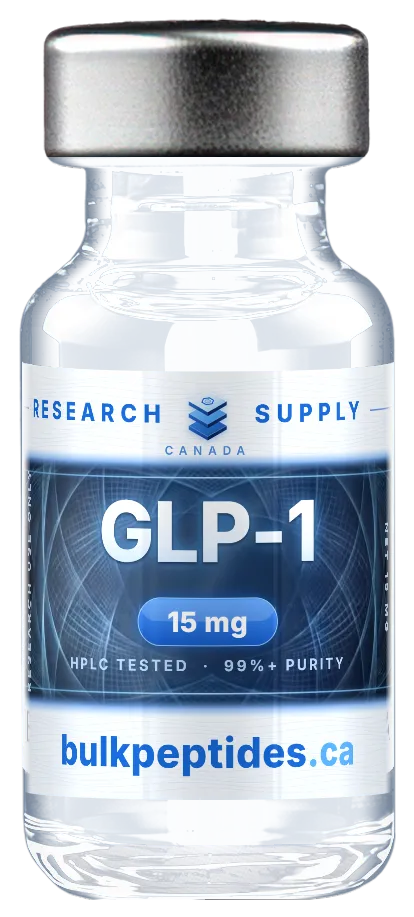
Crimp Seal Vials: Closures, Headspace and Peptide Stability
When a lab receives forty or fifty vials of lyophilised peptide in one shipment, most of the attention goes to the certificate and the cake. The closure gets a glance at best. Yet crimp seal vials, the stoppered and aluminium-sealed format used for most research peptides, are doing a job for the whole time the material sits in your freezer: keeping out moisture and oxygen, holding whatever gas was sealed above the solid, and giving you a way in that does not expose the contents each time. This guide covers how that closure works, what can go wrong with it, and what to check when a multi-vial order is logged into inventory.
Anatomy of a crimp-sealed vial
A standard crimp-top vial has three parts:
- The glass body, usually borosilicate for laboratory and pharmaceutical work, with a flanged lip.
- An elastomer stopper, commonly a butyl-type rubber chosen for low permeability to water vapour and gases.
- An aluminium seal, rolled under the lip to clamp the stopper in place, often topped with a plastic flip-off cap.
The crimping step compresses the stopper against the glass with a fixed force. Once made, that compression does not depend on anyone tightening anything, and it does not loosen as the vial moves between room temperature and the freezer. The coloured flip-off cap has a practical second use: at Bulk Peptides, cap and crimp colours are how vials are matched to their certificate, which makes the closure part of your traceability as well as your storage.
Crimp seal vials versus screw caps
| Feature | Crimp seal | Screw cap with liner |
|---|---|---|
| Seal force | Set once at crimping, uniform | Depends on how tightly it was closed |
| Response to temperature cycling | Stable | Can loosen as plastic and glass contract differently |
| Access | Needle through the stopper; vial stays closed | Cap removed; interior exposed to room air |
| Tamper evidence | Visible if removed | Limited |
| Best suited to | Lyophilised material stored for months | Short-term working solutions, convenience |
Screw caps have a place, particularly for working solutions that will be used within days. For dry stock that needs to last, the crimp format is the conventional choice because of the consistency of its seal.
Headspace: the gas you cannot see
Freeze-dried peptide is usually stoppered inside the lyophiliser. Slotted stoppers sit partly inserted during drying so vapour can escape, and at the end of the cycle the shelves press them home, either under vacuum or after the chamber has been backfilled with dry nitrogen. The vial is then crimped outside the chamber.
The result is a headspace low in oxygen and moisture. That matters most for sequences containing methionine, which oxidises to the sulfoxide and shows up on a mass spectrum as a companion peak 16 Da heavier, and to a lesser extent for cysteine and tryptophan. The dry headspace also protects the cake itself, which is hygroscopic and will pull water from humid air.
A vial sealed under vacuum gives a small clue about its own integrity. When a needle is introduced, it tends to draw air or liquid inward rather than push gas out. A vial that shows no pull is not necessarily compromised, since a nitrogen backfill near atmospheric pressure behaves the same way, but a vial you expected to be under vacuum that shows none is worth noting in the log.
Coring and repeated entry
Every pass of a needle through a stopper has a small chance of cutting a sliver of rubber loose. That sliver, called a core, drops into the vial as a particle. In an analytical sample it will be filtered out before HPLC analysis, and it can take adsorbed peptide with it.
Risk goes up with larger needles and with more punctures. Good bench practice for analytical work reduces it:
- Use the finest needle that suits the solvent volume.
- Enter at a slight angle with the bevel facing up, then straighten.
- Reuse the same puncture point instead of making new holes.
- Limit the number of entries by dividing material into single-use portions early.
That fourth point is the most effective. Our article on aliquoting and vial entry goes into the practice in more detail.
Glass, pH and adsorption
Borosilicate glass expands little with temperature and releases very little alkali into aqueous contents. Soda-lime glass releases more, and over weeks that can nudge the pH of an unbuffered solution upward. For peptides whose solubility or stability is sensitive to pH, that drift is not trivial; see the peptide isoelectric point for why.
Any glass surface also binds some peptide. At working concentrations the loss is minor, but in very dilute solutions a measurable fraction can end up on the wall, which is one reason dilute standards are best made fresh.
Receiving a multi-vial shipment: closure checks
A few seconds per vial at receiving saves a lot of doubt later. For each lot in the shipment:
- Confirm every aluminium seal is fully rolled under the lip, with no lifting or looseness.
- Look for cracked glass or chipped lips, especially on vials near the edges of the carton.
- Check that the stopper is fully seated and not pushed up or pulled in.
- Compare cap and crimp colour against the certificate you are filing the lot under.
- Note the condition of the cake: intact, shrunk or collapsed. A cake that has collapsed can point to moisture exposure at some stage.
- Record the count, the colour pairing and any rejects in your inventory log before the vials go into cold storage.
If the cartons are cold on arrival, let a vial reach room temperature before piercing it. Opening or entering a cold vial in humid air invites condensation, which undoes much of the work the sealed headspace was doing.
Bulk Peptides products are sent for independent HPLC and purity testing, and the certificates we publish for some products are listed on the certificates of analysis page. Orders ship from within Canada, so the sealed vials do not sit in a customs queue before reaching your cold room.
Bulk Peptides sells these compounds for in-vitro research and analytical use. They are not for human or animal use, and nothing on this page describes such use.