Description
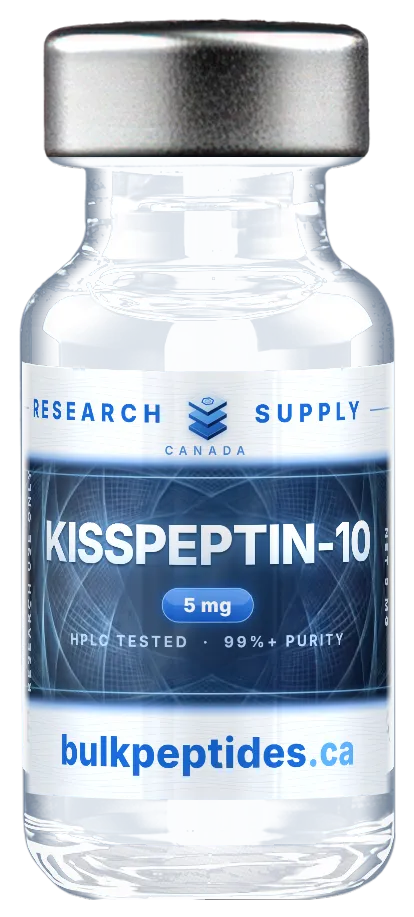
The KISS1 gene produces a 145-residue precursor that is cut into several kisspeptins. The last ten residues, amidated at the C-terminus, are enough to activate the receptor, and that decapeptide is what this vial contains.
Kisspeptin-10 5 mg, the shortest fully active kisspeptin
Kisspeptin-10 has the sequence Tyr-Asn-Trp-Asn-Ser-Phe-Gly-Leu-Arg-Phe-NH2 and a mass of 1302.4 g/mol. The C-terminal Arg-Phe-amide is shared with the wider RF-amide peptide family and is essential for binding KISS1R, the G-protein-coupled receptor formerly known as GPR54.
It is the standard agonist for KISS1R signalling assays, usually measured through calcium mobilisation or inositol phosphate accumulation in receptor-expressing cells. Its tyrosine and tryptophan make it easy to follow by UV, while the amide terminus should be confirmed rather than assumed when checking identity.
Compound identity and specification
| Compound | Kisspeptin-10 |
|---|---|
| Sequence | Tyr-Asn-Trp-Asn-Ser-Phe-Gly-Leu-Arg-Phe-NH2 (YNWNSFGLRF amide) |
| Molecular formula | C63H83N17O14 |
| Molecular mass | 1302.4 g/mol |
| CAS registry number | 374675-21-5 |
| PubChem | CID 25240297 |
| Vial content | 5 mg |
| Physical form | Lyophilised powder in a sealed vial |
| Analysis | Third-party HPLC and purity testing to a 99%+ specification; certificates are posted on our COAs page |
| Supplied for | Laboratory research use only |
Questions about Kisspeptin-10 5mg
Which receptor does kisspeptin-10 activate?
KISS1R, also called GPR54, a G-protein-coupled receptor.
Why is the C-terminal amide important?
The Arg-Phe-amide end is required for receptor binding. The free-acid form is a different, much weaker compound.
How is kisspeptin-10 related to kisspeptin-54?
Both are cleaved from the same precursor. Kisspeptin-10 is the shortest form that keeps full receptor activity.
Research literature
Peer-reviewed studies involving this compound and its class. All findings listed are from in vitro, cell culture or animal models and are provided for scientific reference only. This product is supplied for laboratory research and is not approved for human consumption, clinical, or veterinary use.
- Kotani M, et al. J Biol Chem. 2001;276(37):34631-34636. In transfected cells, measured low-nanomolar binding affinity at GPR54 with phosphoinositide hydrolysis, calcium mobilisation and MAPK phosphorylation. Source · PMID 11457843
- Han SK, et al. J Neurosci. 2005;25(49):11349-11356. In mouse brain slices, measured depolarisation of GnRH neurons and GPR54/KiSS-1 mRNA expression across postnatal ages. Source · PMID 16339030
- Liu X, et al. Endocrinology. 2008;149(9):4605-4614. In mouse GnRH neurons, measured membrane potential, firing rate, intracellular calcium and ion-channel contributions, attenuated by PLC/IP3 blockade. Source · PMID 18483150
Certificates for our compounds are posted on the certificates of analysis page and matched to vials by cap and crimp colour. If the one for this product is not up yet, contact the order desk.
Related research compounds
Browse more compounds in Neuropeptides, or view the full research peptide catalogue.
Supplied for laboratory research use only. Not for human or veterinary use.