Description
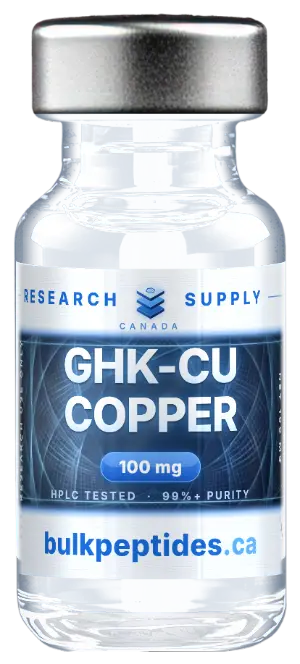
GHK-Cu is one of the few research peptides you can identify by colour. The copper complex gives the powder a blue tint that the free tripeptide does not have, which is a quick first check before any instrument is involved.
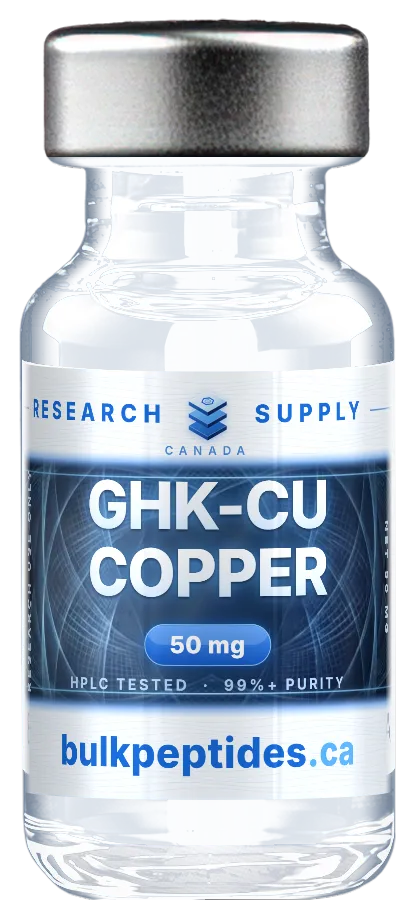
GHK-Cu 50 mg, the copper-bound tripeptide
The peptide itself is only three residues, Gly-His-Lys, but it binds copper(II) with high affinity through the glycine amine, the histidine imidazole and the backbone nitrogen between them. In the vial, it is supplied as that complex. The identity table lists both forms because the free tripeptide (340.38 g/mol) and the copper complex (402.92 g/mol) are reported differently across the literature and by suppliers.
GHK was first isolated from human plasma in the 1970s and has since been used in fibroblast and keratinocyte culture, gene-expression profiling and copper-transport studies. At 50 mg per vial there is enough material for concentration-series work in culture without a second order.
Compound identity and specification
| Compound | GHK-Cu |
|---|---|
| Sequence | Gly-His-Lys, supplied as the copper(II) complex |
| Molecular formula | C14H24N6O4 (free tripeptide); C14H23CuN6O4 as the copper complex |
| Molecular mass | 340.38 free tripeptide; 402.92 as the copper complex g/mol |
| CAS registry number | 49557-75-7 (GHK); 89030-95-5 (copper tripeptide-1) |
| PubChem | CID 73587 |
| Vial content | 50 mg |
| Physical form | Lyophilised powder in a sealed vial |
| Analysis | Third-party HPLC and purity testing to a 99%+ specification; certificates are posted on our COAs page |
| Supplied for | Laboratory research use only |
Questions about GHK-Cu Copper Peptide 50mg
Why is the powder blue?
The copper(II) complex absorbs in the red part of the spectrum, so it looks blue. A colourless powder would suggest the copper is absent.
What is the difference between the 50 mg and 100 mg vials?
Only the fill. Labs using GHK-Cu as a routine reagent usually move to 100 mg for the lower cost per milligram.
Does GHK-Cu need special handling?
Keep it dry, cold and away from light like any lyophilised peptide. Avoid strong chelators in stock buffers if you need the copper to stay bound.
Research literature
Peer-reviewed studies involving this compound and its class. All findings listed are from in vitro, cell culture or animal models and are provided for scientific reference only. This product is supplied for laboratory research and is not approved for human consumption, clinical, or veterinary use.
- Maquart FX, et al. FEBS Lett. 1988;238(2):343-346. In cultured fibroblasts, measured collagen synthesis rates in response to the GHK-Cu2+ complex. Source · PMID 3169264
- Simeon A, et al. Life Sci. 2000;67(18):2257-2265. In fibroblast culture, measured matrix metalloproteinase-2 expression and activity by zymography after GHK-Cu2+ exposure. Source · PMID 11045606
- Simeon A, et al. J Invest Dermatol. 2000;115(6):962-968. In rat dermal fibroblast culture and a rodent in vivo model, measured glycosaminoglycan levels and decorin and biglycan mRNA. Source · PMID 11121126
Certificates for our compounds are posted on the certificates of analysis page and matched to vials by cap and crimp colour. If the one for this product is not up yet, contact the order desk.
Related research compounds
Browse more compounds in Copper Peptides, or view the full research peptide catalogue.
Supplied for laboratory research use only. Not for human or veterinary use.